 Company profile Company profile |

PUBLIC ENTERPRISE
REFORM AND DIVESTITURE
 Manager Manager |
Hon. Matthew N. Rukikaire, Minister Of State Of Finance For
Privatisation.
Read our exclusive interview.
| Contact |
Director,
Privatisation Unit
PO Box 10944
Kampala, Uganda
Phone: ( 256-41) 250 108
Fax: (256-41)259-997 / 242403
e-mail: info@perds.co.ug// mopagi@imul.com
http://www.uganda.co.ug/perds
| Activities |
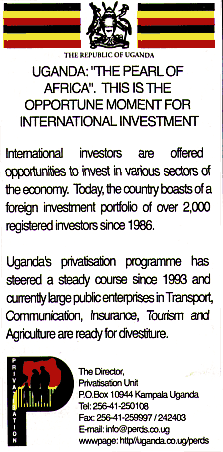
Branch of the Ministry of Finance of Uganda. in charge of the privatisation
for Ugandan State Companies.
| Strategy |
Interviewwith Hon. Matthew N. Rukikaire,
Minister Of State Of Finance For Privatisation.
Q:Focusing on the privatization programme what is your personal
evaluation of the current economic situation in Uganda?
MIN: My personal evaluation is based on scientific evidence which
shows very clearly that on the basis of the economic indicators, we continue to perform
extremely well in the area of macro economic stability and general economic reforms which
include liberalization of all the various sectors ranging from tourism to marketing and
all the other sectors. The performance is continuing to be very good and it is the highest
in Sub-Saharan Africa. We are not however satisfied because although we have been able to
achieve high growth rates, stabilize the shilling and liberalize our economy so that
government is overseeing the economic trends rather than managing them, we have problems
of large scale poverty. I mean poverty in relative terms meaning that poverty has not
reduced as fast as we would like it to. People are better off than they were 10 years ago,
but we know from the ripple effect that the money is not reaching the lowest level of the
community that is the reason why in conjunction with World Bank we have adopted programs
which are aimed at poverty eradication, the Universal Primary Education is one of such
programs and we have a program in government called "Entandikwa" which is a
Micro-credit program, whereby we have put aside money for every sub county which can be
lent to the smallest person 50,000/=, 100,000/= 200,000/= etc. This is aimed at supporting
some tiny projects which are low income generating. Government carries the burden of
lending low income generating projects because commercial banks are not interested. In the
discussions with the World Bank, European Union and other funding agencies we are trying
to deal with the question of poverty eradication once we have that one running together
with the reform program which we think is succeeding then we will move fast in the
economic development of the country.
Q: James Wolfenhson was here 2 or 3 weeks ago and it seems that
international institutions like the World Bank are willing to participate in projects with
Uganda, how would you describe this relationship with the international institutions and
what came out from these meetings? | MIN: I think the meetings which took place here were under the
auspicious of the president of the World Bank and they were very constructive in terms of
getting the leaders to look at regional problems. One of our biggest problem is the flow
of investable funds from the western world, the strengthening of the private sector e.g.
in Uganda we are busy privatizing government owned companies but do we have enough
enterprenuership skills in the private sector to handle economic development? That is one
issue that was discussed. We also discussed the creation of larger markets in this area and larger markets are created only if regional infrastructures are expanded e.g.
road connection between countries in the region, rail and telecommunication. These are
some of the issues which were highlighted in the discussion between these leaders and the
and President of the World Bank agreed to go and look into some of them as critical needs
for Africa and I am glad to say our president spear headed some of these issues.
Q:How would you describe the relationship of World Bank/IMF and
Uganda and what are the main projects that are supported by the World Bank/IMF?
MIN: For the last 11 years the World Bank/IMF have been supporting our
economic program in totality and most especially they have been supporting the question of
lack of foreign exchange. There has been large scale import support from both the World
bank and IMF, and they have supported our budgetary short falls because when we took over
power in 1986, we could not sustain or support our recurrent and development expenditures
because we did not have enough resources and the World Bank and IMF have put up funds to
help us to continue to balance our budget. The World Bank has gone further and provided
funds for specific projects especially roads, communications, power and many other
projects.
Q: Focusing on the privatization program what have been the guidelines
of this privatization, many banks are going to be privatized, telecommunications etc.
Since you have reached a very important stage, what are you expecting?
MIN: We have already privatized about70% and I believe that
once we have privatized Uganda Commercial Bank and sold the SNO (Second National Operator)
license for telecommunications, where we are already negotiating with a company called MTN
from South Africa, and we think soon we will have signed and issued the SNO license.
Uganda Posts and Telecommunications Corporation was restructured to create Uganda
Telecommunications Limited (UTL) which we hope to sell by May this year. By that time, we
would have issued a second license and this will create competition between the SNO and
UTL because both of them will be issuing people with telephones services. Then we have got
what we call the Dairy Corporation which monopolizes the processing of milk. All in all,
once we have privatized: Uganda Commercial Bank, SNO, UTL, Dairy Corporation, Uganda
Airlines, National Insurance Corporation, and Kinyara Sugar Works, I think the task of
divesting government parastatals will be almost complete and the remaining work will be
small then government will turn its attention100% to attraction of new investment
in new areas. Towards the end of 1999 government's task would be to attract new investors
rather than to bring in people to buy the old companies.
Q: We have seen that American Investors have been doing several
investments in the country, not as much as Uganda has been expecting, e.g. Nile
Independent Power, what is your personal evaluation of the American involvement in this
privatization program and the revival of Uganda's economy?
MIN: The American private sector has not been very instrumental in the
privatization exercise as it was a bit distant because of historical reasons. We also had
little communications with Americans and the president has personally spearheaded the move
to make American industry interested in Uganda. We became members of OPC to ensure
investment by the American company. I have had discussions with the vice president of OPC
and Uganda is one of their priority areas. The African Trade Promotion Bill in America is
now before the Congress in both the senate and House of Representative the main aim of
this Bill, if it is to be passed; is to improve trade and investments between United
States and African Countries and one of the aims we are trying to achieve is to see that
this Bill is passed before president Clinton comes.
Q: What are you expecting from Clinton's visit in terms of business
and political relations?
MIN: In terms of political relations, and at the government level the
co-operation has improved e.g. supporting the programme of training armed forces, they
understand the geo-politics of this country. They also understand our political system. We
have not had problems on the political side but we are having problems on the economic
side and we are working on it.
Q: Are you expecting an important business community that will follow
Clinton?
MIN: I believe that when he comes a lot of business people will come
in Uganda and I also believe that once he is here, with the help from your magazines and
others we shall see a lot of American business men around.
Q: What message would you send to encourage Americans to come and
explore business opportunities in Uganda?
MIN: The message we would send is that the old fashioned image of
Uganda is over and we want Uganda to be judged not on what Amin and Obote did to the
international community, but judged on the basis of our achievements over the last 10
years (NRM era of Museveni) in terms of economic achievements, constitutional reform
programmes, democratization and growth rate and we want to impress on the international
business community that Uganda is a new haven for investment, the sky is the limit. |