SEO Version


www.ebizguides.com
120
Industry and Trade
INDUSTRIAL SECTOR IN
ECUADOR
Industrial activity is fundamental for national devel-
opment. The areas include agriculture, fishing and
aquaculture, construction, mining, power engineer-
ing, forestry, tourism and hospitality, commercial ser-
vices, banking, finance and insurance, transport and
telecommunications, development and adaptation of
production technologies, systems, processing and
dissemination of electronic information. Modern in-
dustry is a compendium of knowledge and pragma-
tism and is intrinsic to offering better living standards
throughout Ecuadorian society.
The manufacturing industry contributed $4.363 mil-
lion to the annual GDP in 2008 , representing 8.3%
with a 12.7% increase, compared to the previous
year, when it was only $3.870 million.
Ecuador does not have the same industrial history
as many other countries but slowly and surely, this
sector has seen development. This progress is par-
ticularly visible in Quito and Guayaquil however not
so much in Cuenca.
The fishing market has also become central to the
Ecuadorian economy, particularly in the city of Man-
ta. Fish processing has become very important, in
particular tuna fish. Due to its strategic location, it is
one of the largest ports on the Pacific coast of Ec-
uador. The white spot virus in shrimp has had two
effects on the Ecuadorian fishing industry in the re-
gion: the rise of processed shrimp and the very sig-
nificant growth of the tuna industry, with the intention
of giving more value to seafood.
The manufacturing industry is the sector that con-
tributes most to the country’s economy after trade;
its contribution to gross domestic product is around
14%. Food and drinks are the most significant manu-
factured products in terms of profit.
The most exported industry products are marine
products, motor vehicles and parts, extracts and
vegetable oils, metal manufactured products, juices
and preserves.
The sector’s exports in 2008 grew 15% in value in re-
lation to the amount exported in 2007. However, this
growth was lower than in the three previous years.
In terms of volume exported, the figure fell by 13%
from 2007.
Non-oil industrial exports in 2008 registered a growth
of 13%, but volume fell 9%. Five groups of products
represent 62% of non-oil industrial exports. The
most exported products are:
Seafood: In 2008, $ 890 million of seafood was ex-
ported with a recorded growth of 19% in value whilst
volume fell by 7%. Marine products represent 21%
of total industrial exports. Main destinations are the
USA, Spain and Holland. Canned fish represents
a value of 92% of total exports of marine products.
These exports grew by 21% in value in 2008 whilst
volume fell by 4%.
Vehicles and parts: $407 million’s worth of vehicles
and parts were exported in 2008 with a recorded
growth of 6% in value and a 14% fall in volume com-
pared to 2007.
These exports represent 10% of total exports within
the entire industrial sector.
What are the main industrial exports of Ecuador?
Industrial sector exports represent 23% of total ex-
ports and 46% of total non-oil exports. The industrial
sector imports represent about 43% of total imports.
The branch that contributes most to industrial GDP is
food and drink, followed by textiles and wood.
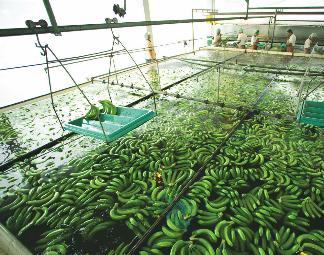
One of themost traditional export product of Ecuador is the
bananas. Source: DOLE
Powered by FlippingBook Publisher