SEO Version


www.ebizguides.com
144
Real Estate and Construction
What does Construction sector represent for
Ecuador?
Construction is the thermometer of the economy.
During 2009, this sector has presented positive
figures that allowed finishing the year with an im-
portant sales increase of 10% compared to 2008.
Building construction that represents 84% of the
total income, has grown 15,2%, from 2 030 mln
USD in 2008 to 2 338 mln USD in 2009, which
means 338 new buildings.
Other activities related to construction, such as
professional services (architecture, design) and
engineering also had positive performance with
an average growth of 2%, from 2 372 mln USD in
2008 to 2 413 mln USD in 2009.
The construction area is responsible for 10% of
the gross domestic product of Ecuador.
As for employment figures, the sector provides
livelihood to at least 300 thousand Ecuadorians
directly, and five times more people indirectly, i.e.
1’500.000 people receive some type of income
coming from construction.
When it comes to taxation, the construction activ-
ity contributes to the treasury with millions of dol-
lars in taxes, contributing to the dynamism of the
economy through public investment.
STRATEGIC OBJECTIVES OF THE MTOP (Min-
istry of Transport and Public Works)
• Address the National Transportation Policy.
• Provides the Country with intermodal and multi-
modal infrastructure with high standards of qual-
ity, safety and efficiency.
• Implements an integrated system of transport
services.
• Improves rail, air, sea and river connectivity of
the country.
Ecuador breaks the public investment record
2010 is the year of public investment. Compared
to 2009, until the end of this year there was an
increase of 1,400 million dollars in real investment
(accrued from the execution of works) of the cen-
tral government and autonomous and decentral-
ized entities.
When it comes to roads, the Ministry of Transpor-
tation and Public Works received an allocation of
INTRODUCTION
ROADS
$ 927 million, of which, until October 24 2010,
$629.87 million were put into action, representing
a compliance of 67.93%.
This investment has provided the country with
necessary conditions to settle private invest-
ment. That is the intention of the Annual Invest-
ment Program. The productive transformation of
the country requires a basic requirement that the
country has the conditions to attract investment,
i.e. roads, ports, airports, incentives, technology
services and possibilities to generate cheap en-
ergy.
Ecuador has the road network of approximately
44,000 km, of which 8,654 km, corresponds to the
state network and the rest to provincial networks
and pathways that make up the urban network.
The Ministry of Transportation and Public Works
is responsible for the administration of the State
Road Network, with a length of 8653.56 kilome-
ters that represents 20% of the total road network.
State Road Network (SRN) is composed of ar-
terial and collector routes. The state network is
composed of arterial roads connecting the border
crossings with Colombia and Peru, as well as
transverse axes that begin at the coast and go to
the Amazon region.
Provincial networks are composed of paths that
allow the output of local production to large re-
gional and national markets.
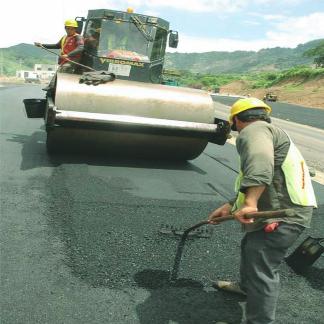
Road rehabilitation iscontinuous inEcuador
Powered by FlippingBook Publisher