SEO Version


173
www.ebizguides.com
Guayaquil
INtroduction to guayaquil The economic capital of
ecuador
Guayaquil, officially Santiago de Guayaquil, is the
largest city in Ecuador, with a metro area popu-
lation exceeding 3.3 million. It is one of the big-
gest cities in Latin America, as well as Ecuador’s
main port. The city is the capital of the Ecuadorian
province of Guayas and the seat of the namesake
canton.
Guayaquil is located on the western bank of the
Guayas River, which flows into the Pacific Ocean
at the Gulf of Guayaquil. 8% of its 344,5 km2 ter-
ritory are rivers and marshland. The city is the
center of Ecuador’s business and manufacturing
industries, as well as a remarkable city for tour-
ism, cultural activities and entertainment. Anoth-
er common nickname among the people is the
“Magic of the South Pacific” or the “Pearl of the
Pacific”.
Historical Background
In Guayaquil and its surroundings, lies the old-
est cultures of the Americas, the Valdivia Culture
dating to 3900 BC. Guayaquil was established
in 1547 as a shipyard and trading port for the
Spanish Crown. It was the first city in Ecuador
to obtain a definitive independence from Spain
in 1820. Then it was the capital of the Province
of Guayaquil Libre, but later was forced to join
the Gran Colombia. In 1830 it was a part of the
Republic of Ecuador as the political center of
the country. The revolution that ousted marcista
militarism abroad, the liberal revolution headed
by General Eloy Alfaro, the May revolution that
changed the government and the constitution of
the time, and in more recent times the leadership
of the project regional autonomy are important
points history of the nation that have developed
in the city.
Guayaquil stands out among the Ecuadorian cit-
ies for its high use of mass transit and diverse
population. The port city is one of the largest in
the Eastern Pacific. 70% of private exports of the
country goes through its facilities, entering 83%
of imports. Also, the shopping center, has dubbed
the city as the “economic capital”. Guayaquil has
a lot of companies, factories, and shops. It con-
tains a wide range of industries, including saw-
mills, machine shops, foundries, tanneries, and
sugar refineries as well as several manufacturers
of consumer goods.
Guayaquileños’ main sources of income are: for-
mal and informal trade, business, agriculture and
aquaculture. Most commerce consists of small
and medium businesses, adding an important in-
formal economy occupation that gives thousands
of guayaquileños employment.
Guayaquil maintains an infrastructure for import
and export of products with international stand-
ards. The Seaport is the major trading point of the
city. The Seaport is the largest in Ecuador and
one of the biggest influx of shipping on the shores
of the Pacific and José Joaquín de Olmedo Inter-
national Airport. Additionally, it has an infrastruc-
ture of roads to other cities and provinces, which
are considered the best in the country.
GUAYAQUIL IS THE MOST IMPORTANT PORT
CITY OF ECUADOR
In 2009, the port of Guayaquil moved 12.37 mil-
lion tons (mt) of cargo non-oil trade, which rep-
resents almost 80% of the total registered in the
country,
(15.48 million tons). For this result, the springs
of Guayaquil Port Authority reported 7.32 million
tons., and private ports totaled 5.05 million tons.
In the same year, Puerto Bolivar registered 1.8
million tonnes., while Manta and Esmeraldas
moved 667,426 and 636,591 metric tons., respec-
tively.
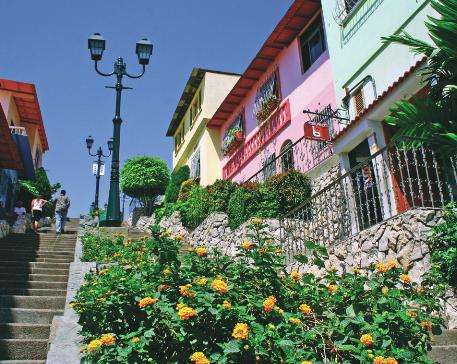
Theoriginal placewhereGuayaquilwas founded, LasPeñas
Powered by FlippingBook Publisher