SEO Version


www.ebizguides.com
24
General Information
Ecuador has three main geographic regions, plus an
insular region in the Pacific Ocean:
• La Costa, or the coast, is comprised of the low-lying land in
thewesternpart of thecountry, including thePacific coastline.
• La Sierra, ("the highlands") is the high-altitude belt
running north tosouth along the centre of the country,
its mountainous terrain is dominated by the Andes
mountain range.
• La Amazonía, also known as El Oriente ("the east"),
includes the Amazon rainforest areas in the eastern
part of the country, accounting for just under half of the
country's total surface area, whilst only populated by
less than 5% of the population.
• La Región Insular is the region comprising the
Galápagos Islands, some 1,000 kilometers (620 mi)
west of the mainland in the Pacific Ocean.
Ecuador's capital is Quito, which is in the province
of Pichincha in the Sierra region. Its largest city is
Guayaquil, in the Guayas Province. Cotopaxi, which is
just south of Quito, features one of the world's highest
active volcanoes. The top of Mount Chimborazo (6,310-
m above sea level) is considered to be the most distant
point from the center of the earth, given the ovoid shape
of the planet.
Climate
Biodiversity
Ecuador is one of seventeen megadiverse countries
in the world according to Conservation Internation-
al. In addition to the mainland, Ecuador owns the
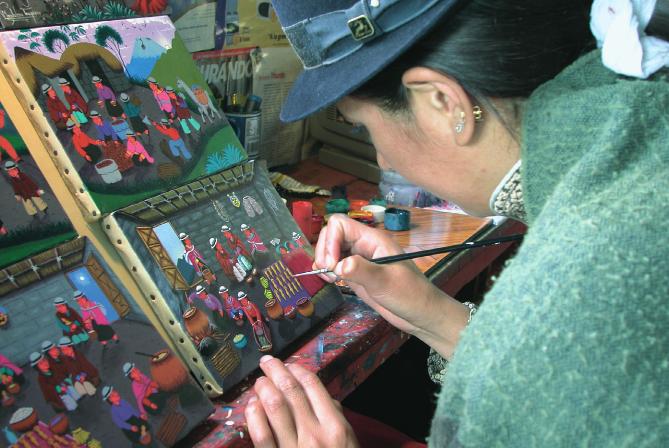
Traditional Tigua painter
There is great variety in the climate which is largely
determined by varying altitudes. It is mild all year-
round in the mountain valleys and there exists a
humid Subtropical climate in coastal areas and rain
forests in the lowlands. The Pacific coastal area has
a tropical climate, with a torrential rainy season.
The climate in the Andean highlands is temperate
and relatively dry. Quito is dominated by the spring
weatherbut can see extreme changes in relatively
short periods of time. The temperature can reach 25
degrees during the daylight hours while at night may
drop to 7 degrees. This same climate is maintained
throughout the year apart from changes to rainfall
levels for 2 to 3 months a year. The Amazon ba-
sin on the eastern side of the mountains shares the
same climate as other rain forest zones.
Because of its equatorial location, Ecuador experi-
ences little variation in daylight hours during the
course of the year.
Powered by FlippingBook Publisher