SEO Version


253
www.ebizguides.com
Agriculture
MANGO PROFILE IN ECUADOR
Total exports:
9.8 million boxes in the season: 2009-2010
Main markets:
EEUU (82%), Canada (7%), Mexico (5%), Europe
(4%)
From October to January, the Ecuadorian Mango:
your best option!
Thanks to its geographical location, Ecuador has ad-
equate luminosity and climate conducive to the cul-
tivation of agricultural products. As a result, different
varieties of mango of excellent quality and flavor can
be harvested from October to January.
The Ecuadorian mango is grown in the coastal area,
mainly in the Guayas Province. Approximately 6500
hectares, which correspond to the export volume of
the product, represent about 84.4 percent of the total
land cultivated in the sector.
The main varieties of export products are: Tommy
Atkins (65%), Haden, Kent, Keitt, as well as Van and
Ataulfo, but in a smaller proportion.
Producers and exporters of Mando have formed
a guild in the Foundation Mango Ecuador, a non-
profit organization, whose main objective is to pro-
vide support to the producers, exporters, industrial
sectors, based on the ecologic and efficient use of
natural resources, with the aim of increasing produc-
tivity, as well as supporting research, education and
technology. In case you need more information on
the Foundation Mango Ecuador, please visit the web
page: www.mangoecuador.org
Development of the sector
Ecuador not only supplies the World with fresh mango,
but also exports this exotic fruit in different presenta-
tions, such as mango puree, cubes IQF, dehydrated
mango, etc. The fresh mango is produced and exported
in a conventional or organic presentation.
Exports and main markets
Ecuador began the cultivation of exportation mango in
1989. However, the Ecuadorian mango began consoli-
dating its position in the international market from the
year 1993. Little by little, exports have been increasing
until they reach 7.3 million boxes (4.2 kg.) during the
season 2008-2009 and 9.8 million boxes during the
season 2009-2010.
To comply with the international phytosanitary require-
ments, Ecuador has 5 hydrothermal treatment plants
that guarantee the eradication of any fruit flies in the
fresh fruit.
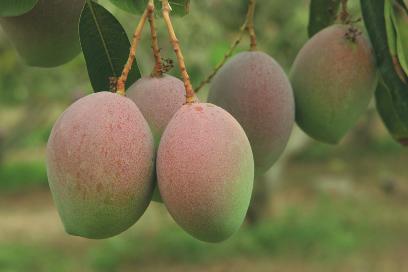
Another exampleofmangos
The main external market is the United States, which
absorbs around 81.85 percent of exports. The sec-
ond destination is constituted by countries of the
European Union, such as Belgium, Spain and the
Netherlands representing 4.31%, whilst Canada
and Mexico account for 7.18% and 5.24% respec-
tively. In addition, in recent years, new markets have
opened their doors to Ecuador, such as New Zea-
land and Chile.
The size of an exported fresh mango varies between
250 and 750 grams, depending on a destination
market. Fruit are exported in corrugated cardboard
boxes containing 6 to 16 units, according to the size
of the fruit. The mango is exported in controlled tem-
perature, between 9TH - 12°.
Total exports:
79,391.32 (2009); 23,829.04 (January-April 2010) in
thousands USD FOB
Main markets:
Netherlands (65%), USA (17%), Canada (3%), UK
(3%)
Passion for the Ecuadorian flavour
Known as a passion fruit, the Ecuadorian maracuyá
is increasingly desired in the international market,
thanks to its exquisite flavor and excellent taste.
Ecuador has a comparative advantage for the pro-
duction of maracuyá, which makes it one of the
world’s biggest producers of this fruit. In fact, the
privileged Ecuadorian tropical climate allows main-
taining continuing harvest throughout the year.
Development of the sector
With a dominant share in the world market, Ecuador
is the main supplier of concentrate (50TH Brix) and
juice (14°/15 Brix) of maracuyá. In addition, fresh
Powered by FlippingBook Publisher