SEO Version


www.ebizguides.com
264
Agriculture
ing their fresh palm hearts, as opposed to wild palm
hearts produced in other countries, a consumer is di-
rectly supporting a form of sustainable farming. Whilst
at the same time preventing the vicious cycle of slash
and burn agriculture.
- 70% of work is given to young women with limited
economic conditions and academic achievements. At
the same time, the company is interested in attracting
and retaining talented and experienced staff, something
which has only come about as a result of extensive
training.
- The company is proud of its commitment towards lo-
cal communities. Partnerships and relationships have
been formed to involve more employees and support
microenterprises within the agricultural industry to ben-
efit both Tropical Foods and these small independent
companies.
As for their industrial and export process, the company
holds various quality certifications that allow it to trade
with Europe, the USA, Israel and various other coun-
tries worldwide. 95% of their production is exported and
they shift an estimated 80 containers per year (1800
cans).
Their portfolio is comprised of 18 different products that
have been commercialized with both their trademark
and with private labels. Their efforts in R&D continue to
increase and they expect to start production of different
and more elaborate palm heart products in 2011. These
products will be oriented towards health-conscious
consumers that are looking for goods that are rich in
vitamins and fibres.
This is a very attractive market for international inves-
tors who want to be involved in the high-quality canned
food industry with a well respected and socially respon-
sible firm that is trusted by many.
Ecuador has one of the best global Palmito markets,
qualified by major buyers in the world, and therefore
Tropical Foods is required to provide the highest quality
palm hearts that fit with international standards.
Daniela Quiñones
General Manager of Tropical Foods
AZUCARERA VALDEZ
Ricardo Rivadeneira
President
Av. Juan Tanga Marengo and Av. Joaquín Orrantia
Executive Center Mezzanine, Guayaquil
Tel: +593 4 297 0117
www.azucareravaldez.com
Area of activity: Sugar production
Date of creation: 1882
Employees: 3000
Azucarera Valdez is a consolidated company with
over 126 years of experience in the Ecuadorian
market. Initially, the company started its activity with
the production of bulk white sugar. Subsequently,
Azucarera Valdez diversified its product portfolio, in-
troducing value-added products, such as light sugar,
brown sugar in blocks and granulated sugar, as well
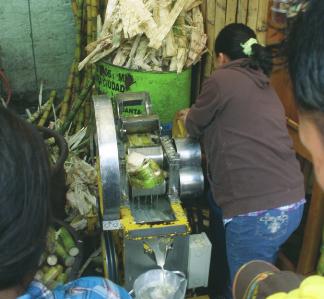
as stick pack, molasses, cane juice and other prod-
ucts.
In 1992, Ingenio Valdez was acquired by the Noboa
Corporation, officially becoming a Valdez SA Sugar
Company. With this acquisition, Nobis Consortium
began the process of modernization of the company.
2007 marked the national production record for Azu-
carera Valdez, with 3.146.671 sugar bags of 50 kg.
The company has a daily crushing capacity of 14000
tons, 20,000 hectares of crop and is expecting to get
an annual production of about 3.300.000 sacks of
sugar and 9.500.000 gallons of molasses.
In 2008, the company reached a new milestone,
obtaining the certification ISO 14001:2004 (Envi-
ronmental Management System) and thereby re-
inforced its environmental and social responsibility
policies. The company is very concerned about its
sustainability and environmental impact and there-
fore strives to minimize levels of residuals and pro-
duce its own energy. Azucarera Valdez is constantly
working on policies and procedures related to in-
novation and continuous improvement, highlighting
efficiency and teamwork as its core success factors.
Azucarera Valdez implements the latest technol-
ogy, such as the diffusion system, with a capacity
of 14,000 TCD. This increases juicing capacity con-
siderably which in turn improves the company’s key
indicators and ensures the maximum quality of its
products. The company invested $18 million in spe-
cialized machinery, making them the first and the
only company to use this technology in Ecuador.
Powered by FlippingBook Publisher