SEO Version


77
The Ecuadoran Economy
The current predictions are that the Ecuador’s econ-
omy will remain in deficit at a rate of 0.6% of GDP in
2010 and 1.6% in 2011 after 1.1% in 2009.
The overall Ecuadorian national budget in 2011 is
set to reach 23,950 million USD.
In 2010, the budget amounted to about 21,282 mil-
lion USD. The proposed 2011 budget, delivered to
the National Assembly for approval, has a fiscal defi-
cit of about 3.734 million dollars and also requires a
further 4,951 million USD in additional finance.
The main sources of revenue to cover the budget
for next year will be taxes and public financing, es-
pecially foreign investment. The project includes
about 3,859 million dollars in foreign loans and
about 1,093 million dollars in domestic loans. The
proposed plan of the Government promotes strong
public investment and the prioritization ofstrategic,
social and productive sectors.
In 2011, public investment is estimated to reach
about 4.691 million dollars excluding the resources
allocated in the state oil companies. Whilst on the
fiscal side of matters, the main source of financing
will be tax, which is projected to amount to some
9,426 million USD in 2011. On the expenditure side,
Ecuador plans to spend an estimated 1.573 million
dollars on debt repayment and about 6.523 million
dollars on wages and salaries. President Rafael
Correa has announced a downsizing in the public
sector. The percentage of debt to GDP is 13.4%. Ad-
ditionally, the unemployment rate will hover around
7.4%.
The draft budget of the smallest partner of the OPEC
also sees production volume of 180.8 million barrels
and exports of 125.6 million barrels. Oil revenues
next year are forecast to reach an estimated 3.507
million dollars. The oil sector would therefore grow
by 1.6 percent, despite the contraction that occurred
between 2007 and 2010 by the fall in production of
private firms due to lack of investment, while waiting
to sign new contracts to provide services.
The signing of new agreements would mean an
investment of 1,200 million dollars over five years,
which would increase the level of oil production
which is ultimately one of the main sources of na-
tional income.
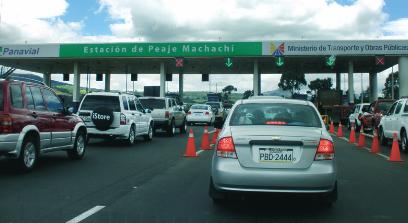
Highway tolls help financing the State budget
PROGRAMMING GUIDELINES
OF THE 2011-2014 BUDGET
AND 2011 PROFORMA OF THE
STATE BUDGET
Macroeconomic Policy
In compliance with the Arts. 283 and 284 of the Re-
publican Constitution and the Goal 11 of the Nation-
al Plan of Good Living - PNBV, the Government’s
macroeconomic program is a tool in changing the
model for consolidation of a social and fair economic
system that ensures the production and reproduc-
tion of material and immaterial conditions that would
potentially raise living standards across the board
in Ecuador.
Macroeconomic Policy must be contextualized
within the framework of Chapter Four Title Six of the
Constitution relating to Economic Sovereignty and
the objectives are defined as:
1. Ensure proper distribution of income and national
wealth.
2. Encourage domestic production, productivity and
systemic competitiveness, the accumulation of sci-
entific knowledge and technology, the strategic in-
tegration
in the global economy and productive complemen-
tary activities within the regional integration.
3. Ensure food and energy sovereignty.
4. Promote the incorporation of added value with
maximum efficiency, within the biophysical limits of
nature and respect for life and cultures.
5. Balanced development of the country, integration
of regions in the country, between rural and urban,
economic, social and cultural.
6. Promoting full employment and enhancing all
forms of work with respect to labour rights.
7. Maintain economic stability, defined as the maxi-
Powered by FlippingBook Publisher