SEO Version


83
www.ebizguides.com
Finance
Investment, Equity and Funds
The ABPE showed that in the first half of 2010 the
number of investment accounts in the private banking
system had grown by 3.78%, representing USD$ 2.659
milion. . This can be compared alongside 2009 when in-
vestment accounts recorded an annual growth of $625
million, an annual increase of 30.74%.
Available Funds Abroad decreased by 3.43% over
the first half of 2010, meaning a reduction of $500 mil-
lion. Consequently, funds available abroad accounted
for 8.65% of the country’s assets posting a balance of
$1.935 million.
The same report showed an average growth of 0.55%
during the first half of 2010 in the private banking sys-
tem, which represents an additional USD$62 million for
the same period. However, this growth was lower than
the one recorded during the first half of 2009, which
stood at 0.70%. This represents a decrease in the
growth of assets.
Currency
In the immediate aftermath of the financial crisis of 1998
and 1999, Ecuador struggled and over thirty banks and
financial institutions went through the hoop.
During this harsh economic period, the former presi-
dent, Jamil Mahuad, decided to take the radical step of
dollarization as it was the only option at the time.
10 years since this change, the overall consensus of
opinion is that it has had a positive effect on the Ecua-
dorian economy,even though the continuity of the mon-
etary system has been effected somewhat.
Dollarization paved the way for the country to recover its
economic stability,in turn leading to the reappearance of
long-term credit and decreasing inflation, which in 2009
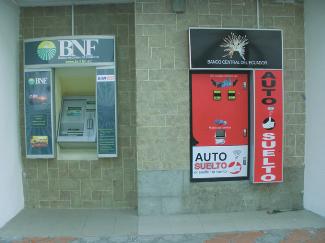
No change? Do not worry and use this machine to get coin
was 4.31%.
The exchange rate of the sucre to the dollar gave some
confidence to domestic industries and sparked better
production. The fear of devaluation generating unfore-
seen losses was eliminated.
To maintain and sustain the dollar, the country must
have enough savings to enable itself to overcome the
harsh blow that the Ecuadorian economy could face –
for example a natural disaster of a severe drop in oil
prices.
Faced with this, the increase in public spending and the
use of savings that the country has in the Ecuadorian
Central Bank and international reserves by the present
government could constitute a risk for dollarization in
Ecuador.
Guayaquil and Quito Stock Exchanges
As previously mentioned, there are two stock exchang-
es in Ecuador, one in Guayaquil and one in Quito.
Quito stands for 45% of the negotiation volumes while
Guayaquil leads with approximately 55%. Companies
can be present in both exchanges. For instance, the
Stock Exchange of Guayaquil has 270 companies and
negotiates more than $ 2.700 million per year. There
has been a “boom” of emissions mainly because ob-
taining financing through stock market transactions is
a very attractive option , with interest rates higher than
7% over 2 years.
The biggest problem facing Ecuador is the lack of stock
market culture, people are not always willing to involve
themselves in it . For this reason, the Quito stock ex-
change has launched a promotion campaign in the
hope of having a national and international impact.
PUBLIC FINANCES AND FISCAL
POLICY
The Constitution states that the State should use taxa-
tion to fund services, investment and public goods,as
well as to redistribute the money fairly across society’s
different social groups. On top of this they should gen-
erate incentives for investment in different sectors of the
economy and promote the production of socially and
environmentally desirable goods.
Additionally, the public finances at all levels of the gov-
ernment, should be sustainable, accountable and trans-
parent as well as seeking economic stability.
In this context, the General State Budget, constitutes
the fundamental instrument of Fiscal Policy:
Powered by FlippingBook Publisher