www.ebizguides.com
12
General Information
www.ebizguides.com
12
The Republic of El Salvador is located in Central
America. It obtained its independence from Spain
in 1821. During the Pre-Colombian period the west
area of the Lempa River was known, in the Nahuatl
language, as “Cuscatlán” or “Place of jewels and
necklaces”.
El Salvador is located in the heart of Central
America, and is 21,000 km
2
. It neighbors Guatemala
and Honduras, and has 300 km of coast line on
the Pacific Ocean. Currently enjoying political and
economical stability because of the thrust given by
the Free Trade Agreement with the United States
and with Europe, El Salvador is poised to play a
growing role as a logistic transportation hub for the
Central America region.
INTRODUCTION
HISTORY
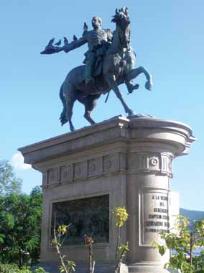
The statue of the General Captain Gerardo Barrios,
statesman and a military hero
Pre-Colombian Period
During the Pre-Colombian Period, the current
Salvadoran territory was inhabited by different
indigenous ethnic tribes: Pipiles, a tribe of Nahuatl
origin, settled in the western and central part of the
territory and the Lencas settled the eastern part.
The most extensive dominance until the arrival of
the Spanish conquest was that of the Cuscatlán
kingdom.
The Conquest, Colonial Period and
Independence
The Spanish conquerors, headed by Pedro de
Alvarado and his brothers Gonzalo and Jesús,
crossed the Paz River in approximately 1524-
1525. They were coming from the area currently
known as the Republic of Guatemala, after having
participated in the conquest of México. During
the Colonial Period, El Salvador was part of the
General Captainship of Guatemala, also known as
Guatemala’s Reign. Salvadoran territory was divided
in two Main City Halls: San Salvador and Sonsonate.
In 1811 and 1814, important rebellions took place
against the Spanish dominion expressing the
locals’ desire for independence. Finally, the Central
American nations obtained their independence from
Spain on September 15, 1821.
Central America Federation Period
Immediately after achieving independence, the First
President of the Federal Republic of Central America
was Manuel José Arce y Fagoaga. El Salvador and
the rest of the Central American countries attempted
to maintain the union inherited from Spain and
created the Federal Republic of Central America,
which dissolved in 1839. In 1851, at the Battle of
Arada, El Salvador suffered its worse military defeat
since its independence. After the dissolution of the
Union, a series of conflicts between liberals and
conservatives emerged lasting all through 1871.
During this period, the cultivation of indigo fell and
the cultivation of coffee was introduced. Between
1871 and 1931, liberal governments succeeded,
favoring the interests linked to the emerging elite
coffee grower class. In 1882, President Rafael
Zaldívar declared the abolition of communal land
and other common land. That land was then sold
to private individuals provoking an abrupt change in
land ownership.
Military Authoritarian Period
In 1929, the country’s economy faced a crisis caused
by the decline of coffee prices on the international
market. In 1931, civilian President Arturo Araujo
Martínez, was ousted from office through a coup