www.ebizguides.com
182
Education
Education Now
34% of the population is comprised of young people
under 14 years old, making 1,800,000 students.
Education in general is acceptable, with a very high
literacy rate in elementary school. It is estimated
that 95% of 10-year-old children know how to read
and write and that the great majority study until
12 years old. There are big differences between
the metropolitan region of San Salvador and the
rest of the departments where the rates are lower.
Approximately, 80% attend private institutions and
20% public institutions.
The educational system is divided in three cycles:
Primary (Grammar): 1st to 6th grade of basic
education; it is free and compulsory.
Secondary (High school): 7th to 9th grade of basic
education (Junior High) and Bachelor (High School;
it is free but not compulsory).
Tertiary: includes some 24 universities, 5
specialized institutes and 8 technological institutes.
The tertiary (university) public institutions are:
Universidad de El Salvador (UES) that has USD$ 60
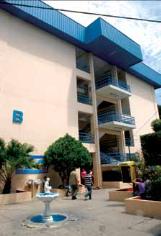
University building (El Diario de Hoy)
million from the budget of the Ministry of Education;
Escuela Militar Capitán General Gerardo Barrios,
Escuela Nacional de Agricultura Roberto Quiñonez
(ENA); Instituto Tecnológico Centroamericano (ITCA);
Instituto Tecnológico de Chalatenango; Instituto
Tecnológico de Sonsonate and Instituto Tecnológico
de Usulután; the rest are private.
There are many private universities that make up
the educational landscape of El Salvador. Here is
an alphabetical list: Albert Einstein, Autónoma de
Santa Ana, Católica de Occidente, Centroamericana
José Simeón Cañas (UCA) (Jesuit), Cristiana de
las Asambleas de Dios, de Oriente, de Sonsonate,
Don Bosco, Andrés Bello, Dr. José Matías
Delgado, Evangélica de El Salvador, Francisco
Gavidia, Luterana Salvadoreña, Panamericana,
Pedagógica de El Salvador, Politécnica de El
Salvador, Salvadoreña Alberto Masferrer, Técnica
Latinoamericana, and Tecnológica de El Salvador.
Here they teach almost all subjects that may be
available in a 1st world country. The Salvadoran
universities are connected to the world through
numerous international programs of cooperation.
As for private institutes there is: El Espíritu Santo
for Higher-education, Escuela de Comunicaciones
Mónica Herrera, Escuela Superior de Economía
y Negocios (ESEN), and Superior de Economía y
Administración de Empresas.
Private technical institute are: Americano de
Educación Superior, Profesionales de la Salud de El
Salvador and the Escuela Técnica para la Salud.
ESEN and ADEN set the standard for business
schools which train students and graduates with
MBA’s (Master in Business Administration) or
equivalent programs. It is noteworthy that because
of the great cultural influence of the US, some of the
Salvadoran students with sufficient funds choose to
study at American universities, or at INCAE, which
is the preferred Business School in Central America
and is headquartered in Costa Rica.
LANGUAGE SKILLS
Bilingual capabilities (English and Spanish) have
been a key factor in the success of contact centers,
business support centers and shared service centers
established in El Salvador, known as “Business
Services at a Distance”. La CEPAL, “Servicios
Empresariales a Distancia”.