www.ebizguides.com
190
Agriculture and Fisheries
AGRICULTURE
Traditionally, El Salvador has been an agricultural
country where close to one third of the territory is
cultivable. The agro-industry is going to play an
important role in the development of the country.
Due to the smalln size of its territory, efforts need to
be focused on attracting investments that generate
high value per square meter.
Agro-industrial companies choose El Salvador as
an ideal destination for their investments because
of its beneficial climatic conditions due to its tropical
weather and the capability to supply the industry
with cheap raw material. Other positive factors are
competitive labor costs and the proximity to the U.S.
market with access to it through CAFTA.
MAG – (The Ministry of Agriculture
and Livestock)
The Ministry of Agriculture and Livestock (MAG)
has a $USD 49 million budget for 2010 with a
decrease of 8.5%, relative to the previous year,
due to the finalization of infrastructure programs in
irrigation, watershed management, flood control and
rural housing. The National Center for Agricultural
Technology (CENTA) will be a hub in the search
for diversification and modernization of agriculture.
Other organisms that are dependent on Agriculture
and Livestock are Instituto Salvadoreño de
Transformación Agraria (ISTA) (the Agrarian Reform
Institute) and la Escuela Nacional de Agricultura
(ENA) (the National School of Agriculture).
CENTA
It is the technical-scientific institution that develops,
promotes and facilitates research and technology
transfer of agricultural and forestry technology for
the agro-entrepreneurial modernizacion of the agri-
business. It is the leading institution of the Salvadoran
system of technological innovation in Agriculture and
Forestry, advising the Ministry of Agriculture and
Livestock, in the formulation of national policy for
scientific and technological development.
COFFEE
Coffee is the primary agricultural product El Salvador
exports. Salvadoran coffee is known worldwide for
its quality, purity and overall quality of consistency
of the crop after harvest. The quality is always the
same.
El Salvador mostly exports washed and Arabica
coffee in its three forms: central standard, high
ground and strictly high ground. It also exports
gourmet coffee according to the guidelines of the
Asociación de Importadores de Café de Calidad
de Estados Unidos (the United States Import
Association of Coffee Quality) as well as special
brand coffees, such as rainforest, fair trade, organic
and Starbucks.
The country has a well kept treasure which is
bourbon coffee, it is a type of coffee very hard to find
outside of El Salvador and is highly regarded among
expert coffee connoisseurs due to its high quality.
El Salvador was the largest producer of coffee in the
world per area, the 1st producer-exporter of coffee
from Central America and the 4th largest producer
in the world for decades, but now produces 1.5
million quintals (1 quintal=100lbs) of coffee. The
main challenge is to replant coffee areas in order
to increase production. COEX and UNEX are the
principal exporters.
SUGAR
The commercial activity of sugar represents 20% of
the Gross Agricultural Product and 2.28% of GDP,
generating $USD 400 million. This is a market that
uses extensive labor and which employs more than
400,000 people. Lately, there have been sharp
increases in international sugar prices that have
offset a lower production.
The National Sugar Association believes that the
country is ready for the use of sugar as a source
of alternative energy and biofuel development, and
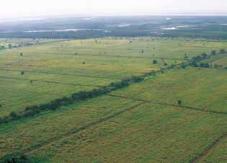
Sugar cane plantation in Usulután