Unilever Ghana is the leading manufacturing and marketing company in Ghana. It is the Company's belief that being successful does not always mean remaining a leader in one's area of operation, but also being responsive to the needs of the community in which one operates and demonstrating good corporate citizenship.As a Company, Unilever is concerned about how it is perceived by those on whom its activities have an impact. The Company believes the performance of its products on the market would, to a large extent, be determined by how the Company is perceived by the public. Also critical to the Company is the image that it carves for itself in the communities in which it operates. For its own success and growth, it needs to show strong commitment to the social and economic development of the country. The level of its sensitivity to issues of national concern should not be in question.As aptly conveyed in Unilever's Corporate Purpose, we are desirous of understanding and satisfying consumer needs at all times and improve their quality of living through innovative ideas and products. To this end, we are committed to outstanding teamwork that would deliver exceptional standard of performance. Building partnerships with our allies in the business is also core to our corporate purpose and to the very survival of our business. Ultimately, our aim is to deliver superior value to our shareholders.
Over the years, Unilever Ghana has made a conscious effort to conduct itself in “the highest standard of corporate behaviour towards … the societies and world in which we live” as we have pledged. It is only appropriate that periodically, the Company finds out how it has fared in the eyes of its publics, and from the perception of the larger communities in which we were serve, thus this survey.
 ACTION STANDARD ACTION STANDARD
Through the survey, Unilever hopes to ascertain what the public's perception of the company is. It would also establish how the public assesses the Company's performance in its desire to be a good corporate citizen. The findings would help Unilever to determine what areas of its Corporate Relations Policy need a re-look in order to enhance the image of the Company and increase its acceptability as a good corporate citizen.
COMPANY VALUES
Unilever Ghana Limited has a set of values that it cherishes and which it would want to be associated with. The company is a committed and responsible corporate citizen of Ghana. This is evident in its contribution to economic growth by offering quality products and services that meet the needs of consumers.
Unilever also generates employment and creates rural wealth through its activities. The Company employs 1,110 people between its Tema Factory and the Head Office in Accra, where Swanzy Real Estates Limited is located. On the Plantations (BOPP and TOPP), there are 1,232 direct employees. All the employees are highly skilled and competent in their various fields. Together with its partners (customers and suppliers) and Third Party Contractors, the Company caters for about 7,000 families. Altogether, it provides for the livelihood of about 87,000 Ghanaians.
The Company helps in creating rural wealth by assisting farmers to establish oil palm plantations on their own land. The farmer only has to make the land available for a period of not less than 25 years. The Company then provides loan in the form of resources for developing the land, seedlings as well as extension services to the farmer.
When the palm trees begin to bear fruits, the farmer is expected to sell the fresh fruit bunches to the Company. 20 per cent of the net sales is deducted to service the loan for establishing the farm. This is what is referred to as the Outgrower Scheme. It is to enable rural farmers to generate some money to improve upon their living conditions.
Another scheme – the Smallholder Scheme – also has the same objective as the Outgrower Scheme but operates a bit differently. Under it, the farmer is allocated a four-hectare plot by the Company, loan in the form of inputs and provided with extension services. He has a repayment period of about 19 years and repays by selling the farm produce to the Company.
In all that the Company does, it takes into account what the priorities and needs of the community in which it operates as well the nation are.
One other core value very dear to the company is innovation. Unilever is a well-managed innovative company, providing value for money with growth prospects and profit sustainability. It seeks optimal local content and value for shareholders' investment.
In addition, the company is committed to developing and applying systems of environmental management as part of its day-to day operation. The company runs its entire business in an environmentally sound and sustained manner. We see safety and health as being part of our product portfolio. Consequently, we make conscious efforts to practice safety in everything that we do.
But by far however, our concern for the environment is what makes Unilever stand out among all manufacturing industries in the country. We are the only Company in Tema with an Effluent Treatment Plant. This was installed in 1997 and it cost the Company 1.2 million pounds. Through the installation of the plant, we have reduced our effluent discharge into the environment to negligible levels. Water is also recycled to reduce waste. This has won us the recognition of the Environmental Protection Agency as an environmentally responsible company.
Unilever would want to be seen as the most preferred employer. Employees are recruited, employed, developed and promoted solely on the basis of qualifications and abilities. The Company provides training and opportunities at both national and international levels to its employees.
A conscious effort is made to recognise excellence and reward achievement. The Company maintains good communication with its employees and keeps the highest standard of behaviour towards them as well as the community in which it operates.
Unilever stands for reliability and uncompromising integrity in all its activities.
COMPANY (BACKGROUND)
Unilever Ghana Limited came into existence on July 14, 1992, as a result of the merger of the United Africa Company (UAC) Ghana Limited and Lever Brothers Ghana Limited, both of which were subsidiaries of Unilever Plc. Sixty-six per cent of the shares of Unilever Ghana are owned by Unilever Plc and the remaining 34 per cent are owned by public and portfolio investors, including about 11,000 Ghanaians.
| From the two companies that merged to form Unilever Ghana, it is evident that the company has its antecedents in 1928, when some British and Dutch firms trading in West Africa merged to form the nucleus of UAC. Some of these trading firms had actually been in the Gold Coast as far back as 1787. Since the early 90s, UAC Ghana has seen a number of transformations.
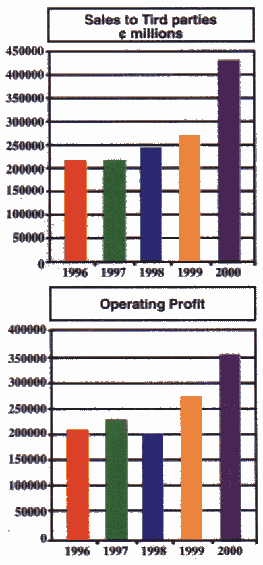
see graph
In 1992, the shareholders of the two companies - UAC Ghana Limited and Lever Brothers Ghana Limited – approved the merger of the two significant Unilever Plc companies. Unilever Ghana Limited was established comprising six divisions: Lever Brothers, Tractor and Equipment, Africa Motors, UAC Textiles, G B Ollivant and Swanzy Real Estate Limited.
In 1997, the restructuring was taken a step further when all businesses considered to be non-core were divested. Unilever Ghana Limited was determined to remain a manufacturing and marketing company. In that same year, the company added DiverseyLever to its portfolio. Then in 1998, it acquired 40% shares in the Twifo Oil Palm Plantations (TOPP).
UNILEVER TODAY
At present, Unilever Ghana Limited is made up of the Lever Brothers Factory and Swanzy Real Estates Limited. It has majority shares in the Benso Oil Palm Plantations (BOPP) and 40 per cent shares in TOPP. From the beginning of this year however, DiverseyLever has been divested.
Being a multi-national Company, Unilever has a number of expatriate staff. Employees of the Company also go for attachment in other countries where Unilever PLC has a presence.
Now a core manufacturing and marketing company, Unilever Ghana has three broad product groups. These are Home Care, Personal Care and Foods.
Under Home Care, we have brands such as Key Soap, Omo, Brillant, Sunlight, Vim and Gift Soap.
Personal Care products comprise the following brands: Pepsodent, Close-up, Geisha, Lux, Rexona, Asepso and Guardian soap. Others are Vaseline, Claricer, Sweetie and Curl Out hair pomade.
The brands under the Foods Category are Holsum, Blue Band, Frytol, “Abeba”, Lipton Tea, Annapauma Salt and the Royco range of products namely Tomaroma, “Shito”, Shrimps, “Dawadawa”, Ginger and Beef.
INVESTMENTS
In the last couple of years, Unilever has made a total of ¢52 billion worth of investment in plant and machinery alone. ¢40 billion has been invested in our brands and ¢2.1 billion spent on training and development of the employees. As a Company, we believe that our employees are our most important assets. Consequently, we invest about six per cent of our annual Net Proceeds of Sales (NPS) in the training and development of our employees.
Training and developing our employees takes various forms; it could be an in-house training programme with resource persons from both within and outside the country. It could also be in the form of an international training programme. At times too employees are sponsored on formal academic courses within or outside the country. In other cases, it takes the form of attachment to any of our sister companies in Europe, Asia, America, Africa or the Middle East.
COMMUNITY INVOLVEMENT
Unilever Ghana is involved in a number of programmes aimed at meeting some of the social needs of the community. These programmes have been consolidated under what is known as the Unilever Ghana Foundation for Education and Development (UFED), with a seed money of ¢5 billion. It was launched in December 1999.
UFED focuses on secondary and tertiary education, academic research, innovation and enterprise development. This is to help unearth talents, build knowledge, skills and capacity towards national development. Under UFED, scholarships have been awarded to SSS students, graduates and undergraduates as well. The company has also sponsored final year students of the University of Ghana Medical School and the School of Medical Science on elective clerkship abroad.
In addition, Unilever has donated fully equipped ambulances to the University of Ghana and rural hospitals/clinics in all the 10 regions of the country. The Company renovated the Ridge hospital Maternity Ward in Accra, donated special microscopes to the Korle-Bu Teaching Hospital, provided a Dental Chair for the Dental Clinic at Maamobi in Accra and has contributed to the National Aids Awareness Programme of the Ministry of Health.
The Company sponsors the Journalist of the Year Award. The World Investment News Ltdr undergoes an Advanced Journalism Course in the UK. It also awards prizes for outstanding performance at the Ghana Institute of Journalism (GIJ), Institute of Chartered Accountants Ghana, Kwame Nkrumah University of Science and Technology, University of Ghana, the National Film and Television Institute (NAFTI) and the University of Cape-Coast.
Unilever has also been a key player in national environmental issues, provides support for the media and other social activities like golf competition and the inter-universities Cross – Country Competition.
The Company's assistance to the communities in which it operates is also very visible in the plantations. Providing and maintaining the roads at Adum Banso in the Western Region where BOPP is located has been the sole responsibility of the Plantations management. The contrast between the roads at Adum Banso and the ones in the surrounding towns and villages is a testimony to the depth of assistance the Plantations is offering.
In addition, the Plantations that generates and provides electricity for the entire township. It is also responsible for the provision of educational institutions for the town's children of school going age, as well as health facilities. |