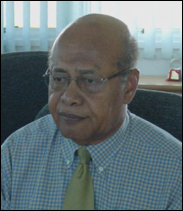
| Mr Koroitamana, a local
newspaper published on Friday that there was going to
be a board meeting to determine whether you would still
be the CEO or not of Airports Fiji Ltd. What can you tell
us about this?
The board meeting has nothing to do with that media
article. It was just a normal board meeting because
we needed board decisions on certain papers, most of
them were approved. One of the things that were discussed
was the question of the allocation of the commercial
space within the renovated building, which we are creating.
It is our task to put together the necessary papers
and make recommendations to the board based on the tender
applications and that is what the board meeting was
all about.
Airports Fiji Ltd. is in charge of the commercial
and safety operations of all the airports in Fiji. In
the current moments that the world is living, how satisfied
are you with the security levels at Fiji airports?
We are building up our security to be able to satisfy
other countries, particularly those whose airlines fly
directly to Fiji or from Fiji here to their country
as first destination. Whatever our security measures
are will have to be acceptable for countries like USA,
Japan, Australia, New Zealand or South Korea as our
flights fly straight from here to those countries. These
countries, at the same time, send their security officers
to check our security measures. We have managed to maintain
an acceptable level but we continue making improvements
and training new recruits in security areas. We are
also improving our systems and equipment, bringing in
the latest technology. We are trying to look at what
is happening and make an assessment of what is the level
that we need to target. At the same time, we are getting
ready for the South Pacific Games. In fact, I prepared
a document last week to put together a plan so that
that we can provide the necessary security for the South
Pacific Games. In our current civil aviation security
legislation, the responsibility for airport security
has been passed on to the police and to AFL. Recently,
we decide to recruit twenty new security officers and
we have had the initial training done by the New Zealand
Aviation Security Company and now we are arranging to
have the second phase of the training so that we can
bring them up to a standard that is more than acceptable.
As far as equipment is concerned, we would have to talk
about the airport development plan that we are now implementing.
It includes the installation of X-Ray machines so the
airlines that wish to have their baggage checked may
do so. We are also looking at new machines to bring
in so that we can work towards meeting the requirements
of the International Civil Aviation Organisation (ICAO).
A part of this requirement is to ensure that each and
every baggage that goes through the counter to the aircraft
goes through X-Ray machines. We are also putting in
place a plan to include domestic flights under this
security measure.
What is the relation of AFL with international organizations
to help funding all these projects?
At the moment we are talking to the Asian Development
Bank through the government. They are going to carry
out a study of the airport requirements, particularly
looking at the facilities we are providing in our renovation
plan. This study should start sometime within the next
month. At the end of that we will make an evaluation
in order to see how to approach their report based on
the master plan that we have, this way we will be able
to make any improvement based on all that and then we
will be able to look at the funding possibilities of
some of the projects we have in mind particularly under
phase II of the master plan. In the meantime, all our
funding requirements are being met from loan facilities
available on-shore.
Your vision has always been to set Fiji Airports
as the gateway to the South Pacific. In order to achieve
that, there are various things that need to be done
as to update the technology. What can you tell us about
the new air traffic management centre you installed
and other similar measures?
Our vision is that Fiji becomes the hub of the region
in air transportation. In order to be a major centre
in the South Pacific we have been improving our technology.
The new Air Traffic Management System is a method that
uses satellite technology. As you are probably aware,
the world aviation is moving from a ground based navigation
system to a satellite based navigation system and Fiji
has been very much involved in this technology from
the very beginning. In fact, we were the first country
in the world to approve the use of GPS for domestic
navigation purposes in 1994. This new system, the new
air traffic management centre, is made by THALES, a
French company based in Australia, and it gives us the
capability to manage and control aircraft flying far
beyond the area that we are currently looking after.
The capability of this new surveillance system is giving
us a potential that we did not have here before and
can cover traffic within airspace as large as 7-10m.
sq.km. This system is used now in many countries like
Australia, China, Singapore, Tahiti, Fiji and others.
There are other projects that we are going to do this
year like the renovation of the Control Tower with updated
equipment using the latest technology. We are actually
constructing a new Control Tower at Nausori, the airport
in Suva, with new equipment and we will make sure to
link that Control Tower to the new air traffic management
system so that the technology is compatible.
Last year AFL started a policy to gradually lower
the price of the Fuel to become one the lowest in the
region to attract more airline movement. How has this
increased aircraft into Fiji and what other similar
measures do you have in mind?
We have had more aircraft movement into here particularly
immediately after we lowered the price of the fuel.
The number of freight carrying flights went straight
from two per week to five per week. We have had certain
military flights, and also other type of flights, coming
through to pick up fuel. We also decided not to increase
charges to airlines hence we are maintaining the 1997
level of charges. We have communicated with the International
Air Transport Association (IATA) to tell them about
all these measures and also to ask them for a meeting
this year in order for us to have our first discussion
with them as "Airport Fiji Ltd.". We have
not had any meeting with the IATA Charges Group since
the Civil Aviation Authority of Fiji days. We used to
have annual meetings with the Group to discuss charges
and to agree to any changes proposed. Since the formation
of Airports Fiji Ltd. there has not been any meeting
with them. This year, because of our development plan,
we need funding and we have done what is now a common
practice in other parts of the world, whereby we have
asked the government to introduce new fees based on
the "user-pay" principles, two of these are;
a development fee, for upgrading facilities, and a security
fee, which are now very common in the sector. What we
are trying to do at the moment is to make this place
more attractive to the airlines and make of Fiji an
air transportation hub in the area. In order to accomplish
this we have to be very careful with the rates we charge
so we have to balance our cost opportunity. We are also
very much aware of what is going on concerning the threat
that the War on Iraq represent for the whole industry
and how is it going to affect the airlines so we have
to be in a position to try and assist the airlines and
assist the industry in surviving through these difficult
times. All these issues are being taken into account
and now it is just a matter of talking it over and establishing
the link with IATA.
Concerning the renovation process of the Nadi International
Airport. Why this renovation and in what aspects will
it improve the Nadi Airport?
This place has not been upgraded for many years so
we needed to bring it up to international standards.
We needed to look at issues, which enhance safety as
this is a major issue for any Airport. We are also upgrading
the traffic management centre, the Control Tower, etc.
All these have to do with safety issues. But we also
had to look at how to increase our revenue as we are
also in charge of the commercial activity of the Airport.
The Nadi Airport was designed many years ago and only
for passengers flow, it was not designed for commercial
activities and this is what we are changing. In this
development we are providing many extra square meters
of commercial floor space so that we can get some income
from these activities. These are the approvals that
I commented on before.
How satisfied are you with the current state of
the works?
We are currently occupied with implementing the first
phase of the master plan, the upgrading of the building
and most of it will be completed this year. The work
is going very well. In fact, I was there this morning
before coming to the office and I can assure you that
we will be ready before the South Pacific Games. After
that we will move into the pavement. We have to repair
the damaged apron area and also extend the main runway
but this will be a totally separate project and it has
to be tendered out. We are currently assessing the tenders
for a study of the dimension and the extension of the
work and this study should commence this month. We are
looking at starting the pavement work this year because
there is a big demand by Air Pacific to lengthen the
runway so that they can carry more freight to destinations
like Japan or USA. Concerning the Nausori Airport, the
airport in Suva, we are making a final analysis on the
tender documents to renovate the present building because
we were looking at completing the work before the South
Pacific Games there as well but only to renovate the
present building. We were looking at the possibility
of expanding that building but there is a difficulty
in Nausori at the moment. It has been labelled "Black
Star" by the International Federation of Airline
Pilots Association (IFALPA) because the runway width
is not wide enough and the length is not long enough.
If we need to widen the runway then the present terminal
building becomes an obstruction so we will need to remove
it. Therefore, we do not want to spend too much resources
on the present terminal building and having to remove
it shortly after.
|
Singapore Airport Consortium
is in charge of the works. Why were the Singaporeans chosen
and in what ways does their participation add more credibility
to the works carried out?
We actually hired them back in 1993 to come and do
a review of our master plan. This Singaporean company
is considered the best in the world when it comes to
airport consultancy and development and they did a very
good job at that time. As a matter of fact, the previous
government, ruled by the Labour Party, continued to
look to Singapore for assistance on airport development.
Then Prime Minister, Mr. Mahendra Chaudhry, wrote to
the Prime Minister of Singapore in 1999 asking for assistance
in developing our Airports and Ports. By the time that
the Airport study was supposed to start the coup of
May 2000 happened so it did not eventuate then. When
I came back here I negotiated with the Singaporeans
and it continued on.
All these measures, lowering the price of fuel,
improving the technology, expanding the airport is helping
Airports Fiji to become the gateway to the South Pacific
but, What is your Marketing strategy to make sure that
people in the global markets are aware of this?
We are trying to reorganise our organization. One
of the areas we are lacking at the moment is marketing.
I am currently considering a marketing arm so that we
can market our Airports overseas. In the meantime, we
are trying to use our Internet Website the best we can.
But we are actually communicating directly with the
airlines. We met Qantas in Sydney a month ago and we
have written to IATA to explain to them what we are
doing. Now, we need to concentrate our efforts on how
to market our Airports abroad hence the importance in
participating in the promotional efforts of Government
through the Far Eastern Economic Review magazine.
The land issue is one the things that hold back foreign
investors from coming into Fiji. You have suffered this
problem recently. What would you tell to foreign investors
concerning this issue?
When the assets were transferred from the Civil Aviation
Authority of Fiji (CAAF) to this company, all the assets
were transferred across except the land and CAAF housing.
The Civil Aviation Authority of Fiji still holds the
lease on the land at Nadi Airport. The lease on airport
land at Nausori and other domestic airports remains
with the Ministry for Lands and Mineral Resources. The
difficulty we are facing now is that because we are
using the land, any actions by land owners tend to affect
us more than the lessee. We cannot negotiate directly
with them because the land is not with us. Now we are
trying to have some of these sites transferred to us
so that we can go directly to the Native Land Trust
Board ourselves. We have had two meetings with landowners
of two beacon sites at Nadi Airport and they are satisfied
with the progress of negotiations. We should settle
these two sites shortly. My message to international
investors is this that, after the completion of our
master plans, we have received a lot of interest from
overseas companies on their interests to be involved
in the upgrading works to follow. Our current terminal
building contractor is Neocorp of Singapore in joint
venture with International Shopfitting (Fiji) Ltd.,
a local company, is an example. The Asian Development
Bank is also interested in providing funding for some
of our projects. Currently, they are tendering for a
study to be carried out to establish the funding needs
and a lot of overseas companies, from Australia and
New Zealand as well, have shown great interest.
The local press has not been very friendly with AFL.
Same thing happened to Fiji after the events of May
2000 and Fiji now has a very negative image amongst
foreign investors. Fiji needs to increase significantly
FDI. What would be your message to the international
business community about this?
We are trying to create employment here. In order to
create employment we need investors but one of the difficulties
that this organization faces is the past strong negative
influence of one particular Union. This Union is well
known to support more pay with less work. Several organisations
have started to be commercialised and we need to be
looking at how to be more productive and more profitable.
We have been asked to return to the government a certain
minimum percentage of return on our assets every year.
If we continue with the old conditions of employment,
I do not think that AFL will be able to achieve this
minimum return. On the other hand, we want to give investors
the opportunities to make a profit for them and at the
same time to create employment in the country and development.
Personally, I believe that is what we are all looking
for at the moment. One of the reasons the media has
not been really friendly to us is because they just
do not appreciate the change that is necessary for our
survival. They are looking after their own interests
in most cases while we have to look after the interest
of this organisation and the country. That is really
one of the reasons why we decided to have this master
plan, so that we can plan ahead and help bring in more
foreign investment. At the same time, tourism will be
a major source of foreign exchange for many years and
we need to be able to cope with the increasing volume
of tourists arriving into Fiji. We have to cope also
with the requirements of the international community
on air transportation.
Year 2001 was not a good year in Fiji. What can you
tell us about your financial results in 2002 and your
expectations for 2003?
The return we have to give to the Ministry for Public
Enterprises is between 10% and 15%. That is the return
we are required to give to the government but at the
moment we are operating well below that. Our assets
are around F$80 million so we are looking at F$8 millions
to F$12 millions. Our last financial year ended up with
a loss for many reasons. One of the difficulties we
now face is the non-contribution from Government for
the operations of Nausori and Domestic airports as per
the provisions of the Public Enterprise Act. Their last
contribution was for the financial year 2001 of around
$3 million. Others are the take over by New Zealand
of part of the Nadi FIR and the non-introduction of
airport development and airport security fees. For this
year 2003, with our new commercial areas that we are
creating, we are looking at an increase of our income
of about 33%. Last year we had revenue of around F$30
million and this year we are looking at around F$40
million. We are not expecting any contribution from
the government at all, what we have to do now is to
concentrate on increasing our revenue from non-aeronautical
sources to beyond 50% of our total revenue. This will
be achieved through the provision of more commercial
spaces in our future terminal building developments
and increase rentals due to improvements made to the
buildings. A lot can be done for Nausori Airport to
increase revenue. The new terminal building to be built
if the "Black Star" is to be removed should
provide for new commercial floor space to increase revenue
and reduce subsidy by AFL from income earned at Nadi
Airport. Nausori has a lot of potential and opportunities
and should be taken advantaged of. The traffic growth
is there and will continue once improvements are made
to enhance safety and improve capacity. With growth
in visitor arrivals into Fiji, it is important that
every effort is made by all stakeholders to increase
the per passenger buying power at airports and raise
the present spending power from a low $2-$3 per passenger
to a higher figure.
Our readers like always to know more about the person
behind a company or an institution. Mr. Koroitamana,
could you tell us more about your professional and personal
background?
I am fortunate because I have been working here for
a long time. I started as an air traffic controller.
I was trained in Australia and New Zealand and then
I worked my way up until I became the CEO of the Civil
Aviation Authority of Fiji from 1982 to early 1998 when
I had to retire. I then entered politics when I joined
the interim Government as Minister for Civil Aviation,
Tourism and Communications for seven months. I came
back as Chief Executive Officer of AFL in 2001 to pick
up from where I left off in 1998. During the period
of my return, AFL has installed and commissioned the
new Air Traffic Management System using satellite technology
and will soon complete a major upgrading work of the
Nadi Airport terminal building. A limited upgrading
of the Nausori Airport terminal building will also be
completed by mid this year. A new Control Tower and
Fire Service buildings will be constructed at Nausori
Airport soon to be completed by next year. A new surveillance
system for aircraft operations in domestic airspace
is also being considered to enhance safety. Planning
for all these new satellite systems started in CAAF
when I was its Chief Executive and also Chairman of
the Asia Pacific Air Navigation Planning and Implementation
Group (APANPIRG) from 1992 to 1998, the group that was
putting together the regional plan for the implementation
of the satellite technology in the Asia/Pacific Regions.
|