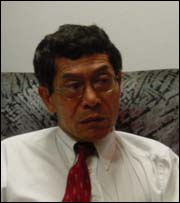
| As Chairman of the Fiji
Electricity Authority, what can you tell us about your
plans to develop renewable energy sources and how do you
measure the importance of this for Fiji?
FEA supplies virtually all the electricity energy
needs in Fiji, 70% of that energy is already renewable.
Our aim is to be a totally renewable company by the
year 2011, in other words, by the end of this decade.
That means that we now have to use the technology that
is now moving into much more affordable range (like
wind-farming and more hydro) that could replace the
30% of oil energy source. This latter source creates
environmental issues like carbon emission and global
warming for instance. What the country also suffers
from every time we import fuel is foreign exchange drain.
This is about 30 million dollars a year for FEA fuel
alone. If we can replace that by wind energy, other
hydro source or Biogas, clearly there is a national
benefit in terms of foreign exchange savings, in terms
of environment compliances, etc.
We are also importing technology because Fiji is too
small to be conducting R&D by itself. As we move
forward with renewable substitution, FEA is partnering
with overseas technology companies, firstly so that
we can have access to technology and secondly, so that
we can have access to global practices. We are too small
and to isolated to keep reinventing the wheel even if
we could. Our joint venture negotiations are now in
various stages of completion, all of them comply to
these basic criteria.
What are the privatisation plans of the FEA?
You have to ask the government about that, it is the
only shareholder. I do not know of any plans to privatise
the FEA and the Board is not looking at it. What we
have to do though is to be competitive globally in terms
of deliverables such as energy cost. We are cheaper
in electricity tariffs, by the way, than countries like
Japan, Portugal, France or Germany, that is what people
do not realize. Another deliverable is power reliability.
Our Fiji customers have suffered greatly from Power
reliability in recent past and we have to improve this.
The main complaint is the duration of outages. We have
to ensure there are few and the outages are never long
enough to put business out of operation. We are striving
to improve this with the use of technology and work
practices and we are benchmarking ourselves internationally
so that it becomes a point of focus in the future.
As Chairman of the Fiji Audio Visual Commission,
as compared to other competing sites as an audiovisual
production destination, what would you consider to be
the competitive advantages of Fiji?
First and foremost our tax incentives have the edge
on most. Further, for foreign investors in this field
the government has already announced and had been past
through Cabinet a rebate amendment for foreign investment
who produce audio and film productions in Fiji and that
will be retrospective to the 1st of January. That will
make it much easier for American companies from Hollywood
or Indian ones from Bollywood. They can come in and
run their productions. They do not have to worry about
double taxation, as we have a rebate system which is
15% for a certain minimum amount of expenditures spent
in Fiji. Anaconda II and other productions are looking
at Fiji as a result.
What is the uniqueness, what are the concrete advantages
that the Studio City offers that other similar countries
do not present?
Second to none the tax incentives are clearly one.
Ideal locations for beaches, jungles, rivers, rugged
tropical mountains, etc. We have a competitive advantage
to other countries because of our culture, which is
unique as a result of our isolation. Be it for movies
or for documentary type of production, it offers great
attraction in a film. We also speak English as the first
language. We have a lot of budding actors and actresses
that can be available locally without having to import
them from abroad. And we have the Studio City, which,
in its ultimate conception, is a one-stop shop film
and audio production centre with tax free incentives
for those who settle and are based in the Studio City.
Overseas employees earning over $100,000 FJD a year,
especially big stars, are tax exempt under the Act.
The Southern Cross Cable Network which connects through
Fiji is a big conduit that allows us access to the rest
of the world via electronic means; it is the door to
the rest of the globe. The Southern Cross Cable, for
instance, is capable of running over a 1,000 full-length
movies simultaneously. This is a major opportunity for
Fiji's economic growth.
The Studio City Project is one of the most important
for Fiji to attract the FDI that the country needs.
What are the activities or initiatives you undertake
to promote this project?
The Studio City is a private sector driven project.
The Fiji Audio Visual Commission is the regulator of
the industry. Studio City backers believes in Fiji enough
as to put in their private money to develop the concept.
They will have scaled downa replica of famous New York
City streets, video archives, and they will be connected
to the Southern Cross Cable Network. In other words,
state of the art stuff. At the FAVC, we promote Fiji
and we promote the Studio City as an asset, which people
can use. The fundamental mandate however is to ensure
that the foreign investors are aware of the tax incentives,
that they are aware of the wonderful location that they
can use to shoot scenes, that they are aware of how
friendly the people are, that they are aware of the
easy bureaucracy provided by the FAVC.
|
As member
of the Shell's board, the protection of the environment
is one of Fiji's priority for the future of the country.
What can you say about Shell's activities in Fiji concerning
this issue?
For all of us at Shell, health, safety and environment
have always been a top priority. Shell, locally and
globally, has a triple line responsibility: Community,
environment and profit are of equal rank. That gives
you the sort of emphasis we put on our environment.
We are moving towards providing renewable energy resources.
Shell locally is a marketing company and not a production
or refining company. It markets environmentally friendly
products such as lead free fuels, etc.
Mr. Mar, form your point of view, what should the
international business community be looking at when
they look at Fiji's economy?
I think people should be looking at the resilience
of the economy of this tiny little nation. Unfortunately
for us, we have some unfortunate recent events of history
(recent coups) but equally history showed that we bounced
back quite quickly. Most important of all, history also
showed that there has not been in Fiji large scale and
widespread destruction and killing. The very last one
was probably the worst but compared to what is happening
elsewhere in the world it is minor. People have to look
at how quickly the economy has bounced back from the
disaster. Most of the foreign investors who were here
at that time stayed. We have seen it all before and
we knew we were going to bounce back. At the same time,
I believe there is a very strong will right across the
nation that that what happened will not take place again.
Everybody understands that if it happens again the impact
will probably be so disastrous that the recovering time
would be a lot more difficult. In the political and
business sectors, in industries and amongst rural areas
people have gone through the shattering impact of the
previous coups, they would not want that to be repeated
again.
Law and Order is a must to attract FDI. We have heard
a lot the words: Unity and Reconciliation, how would
you describe the new Fiji that is currently being built
and the current investment climate in the country?
In relation to law and order, it runs on two levels
and will depend to whom you speak. On one level the
biggest test for law and order has come through with
flying colours. That is the perpetrator of the 2000
events is now in jail. The court system worked and the
court decided. This government has often repeated that
it will put up with any court decision as regards the
issue with the Labour Party court challenge. The Prime
Minister, whatever the decision is, will respect it.
On another level which is in terms of what happens on
the street, it is no difference to any part of the world.
You can get robbed in Australia, in NZ or in any other
part of the world as you can get robbed in Fiji. In
relative terms our media in Fiji, unfortunately, tends
to sensationalize the things that would not become news
in other parts of the world. In the same token, I am
not denying that we do not have a crime problem which
is affecting investor confidence, I am merely saying
that it is probably no different to other countries
but the Government must tackle this with vigour to improve
foreign and local investor confidence.
As for the business climate, I think it is very positive
because the government is targeting investment as a
cornerstone for further economic recovery and actually
doing something on the ground with infrastructure and
venture money to help. They aren't just talking.
What would be your advice to those foreign investors
coming into Fiji from now on?
Apart from normal due diligence work and your visit
to the Fiji Trade and Investment Board, try and understand
the culture in Fiji as a pre requisite. That is spend
time understanding what is the necessary protocol to
ensure that the locals actually get on your side in
order to help you with your project. If you come in
with a bombastic approach it will be very difficult.
Get them on your side as part of the team by speaking
to them on basic issues and with respect. I am talking
about landowners, workers and the government. There
is a way of approaching the bureaucracy that will give
you a result. Put everything on the table as people
will want to help resolve issues if you respect them.
After all, Fiji is a small place and a small economy
and your investment of whatever size is important.
Mr. Mar, you are an example of a success businessman
that is in Fiji instead of in other country in the world,
why?
My professional career has mostly been overseas. I
worked very early in my career in a global oil company,
Shell, and most of my career has been outside Fiji and
mainly in Australia, New Zealand, Asia and Europe. I
owe a lot to Fiji in terms of education and early opportunities.
I became Chief Executive from 1988 to 1992. My last
position in Shell before I retired in 2001 was Chief
Executive and Managing Director of a service company
serving the Arabian region, Asia, Australia and New
Zealand. With these kinds of global exposure, I believe
I have an obligation to come back here and help in the
corporate sector as the government may please. So after
retiring from Shell I came back home, to Fiji, to help
out in any way I can. I feel fortunate to have been
given the challenge to be on the Boards of some of the
key organisations in Fiji so that I can fulfil some
of these obligations. To be honest I am quite driven
by a desire to lift the level of corporate management
skills in Fiji.
|