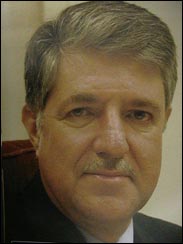
Mr. Richards, FINTEL is a joint-venture between The
Fiji Government and Cable & Wireless UK. As an example
for foreign investors, how would you say a multinational
like Cable & Wireless has benefited itself from entering
in partnership with a Government owned company, what is
the level of satisfaction so far?
Cable & Wireless has been here since 1902 operating
the international communications over the years up until
1976. In December 1976 the government started participation
in the company. At first it took 20% of the shareholding
and gradually it increased its level to 51%. FINTEL
as a company was established in 1976. I have to say
that it has always been a very good relationship. Cable
& Wireless values the long-term relationship with
the Fiji government and has played a major role in developing
communication facilities in the country. The main contribution
is the power of the Cable & Wireless group and its
world wide reach, operating in 70 countries. We can
use those international connections with the group to
benefit Fiji as a whole. This company is one of the
oldest one in the country.
FINTEL is Fiji's only licensed international carrier.
What are the existing facilities FINTEL uses and what
are your plans to improve those facilities?
At the moment we have access to the Southern Cross
Cable Network, with a full landing here at our station
in Vatuwaqa and a satellite earth station. The plans
to utilize all the capacity is to bring into Fiji broadband
transmissions and all the benefits associated with broadband.
This means all the applications and the content including
ISP, voice, ICT, etc. We use the satellite for the thin
routes around the Pacific and also for domestic communications
to Rotuma for Telecom Fiji.
FINTEL invested 45 million FJD in the Southern Cross
Cable Network. What are the main benefits that FINTEL
has got out of this investment so far?
FINTEL has been able to offer to Fiji and its users
a very high capacity, high speed and high reliability
to international access. Our main customer is Telecom
Fiji as most of our traffic goes straight to Telecom
Fiji. We are the link between the domestic operator
and the world. We offer everything that any customer
might need as we have full access to the Southern Cross
as well as to the satellite in terms of connectivity.
We have so much capacity available today that whatever
the customer needs we tailor our network to meet their
requirements.
One of the reasons why FINTEL got into the SCCN is
because of the opportunity for multinationals to establish
call-centres, Tele-medicine or other Tele-services in
Fiji. What are the advantages that Fiji presents for
IT investments and what is the response so far?
We have always had cables running through Fiji since
the early 1900's. The first one opened in 1903 and then
we had the opportunity, when the COMPAC and ANZCAN cables
were taken out of service, to have Southern Cross landing
in Fiji. There was no technical need for the SCCN to
stop here but we saw the opportunity with the government
to ensure a full landing of the SCCN. Now we can offer
a huge benefit to Fiji. We looked at the future growth
pattern of telecommunications not just in Fiji but within
the region and around the world and we saw there was
a need to bring in the SCCN to complement the satellite
network and also to open an alternative and a higher
bandwidth and a higher reliability to our network.
And what has been the response so far?
The response has been quite poor to date. The domestic
carrier has only 6MB of Internet capacity and up until
now there is no international Call Centre operating
in Fiji. We have had discussions with several potential
Call Centre Operators but as yet nothing has come to
bear fruit. We are still talking with them.
What is your feeling about those negotiations and about
the future and eventual arrival of Call Centre Operators
into Fiji?
I think that eventually we will get one to start operating
with us in Fiji. I believe that at the moment there
is some uncertainty due to the 2000 coup and due to
a perhaps untrained workforce. They are generally concerned
about the infrastructure and some of the Union activities
in Fiji. But Fiji has an English speaking population
and the labour rates are very low at the moment. We
have good communications in Fiji, high capacity, etc.
We have plenty of space and land available for renting
at good rates. FINTEL itself has lots of land which
could be used for Call Centres. We can provide the building,
the land and the connection to the SCCN very quickly.
We have plans already drawn up, the architect's drawing
and everything ready to be used for Call Centres. There
is no barrier at the moment to settle a successful Call
Centre in Fiji. For the audiovisual industry that is
looking at coming to the Studio City in Fiji, they have
everything, in terms of communication, almost at their
doorstep, including the access to the Southern Cross
over in Yaqara.
FINTEL is Fiji's only licensed international carrier
but now Telpac has brought in cheaper costs. There is
a controversy concerning this issue. A telecommunications
regulator said recently that "the course now was
to work and not to fight". How do you think FINTEL
should react?
We are the licensed operator to operate international
telecommunications and Telecom Fiji is licensed to operate
the domestic telecommunications, both are exclusivities.
That is the situation today. Other players come in and
start operating without licenses and this contravenes
the local laws and regulations. We have to work closely
with the government to make sure that our license is
observed and respected. I think there is plenty of opportunity
for competition but I believe the network should be
protected for the time being because of the huge investment
that Telecom Fiji and FINTEL have made building and
maintaining the networks. We believe there is room for
competition in the ISP, potentially in the mobile market
and in the supply of customers equipment, that is already
liberalized and that has been liberalized for two decades.
Nobody rejects the competition as long as it is "controlled".
There's no point, in the South Pacific Islands, in simply
opening the markets completely overnight. The markets
are very small and the cost to operate in the region
is higher than in Europe or in Asia so we should be
careful of how the competition is brought into the market.
We will welcome competition as long as it is managed
properly and it is in accordance with certain processes
and with the regulatory framework in the country.
And what should be the government's reaction taking
into consideration the consequences that this issue
might have from a foreign investor point of view?
I think the government has to actually uphold exclusive
agreements. It is not good for the government to open
up to competition overnight when there are still exclusive
licences in operation but we are happy and willing to
talk to them and to work together towards a managed
path to competition. We have invested tens of millions
of dollars, Telecom Fiji has invested hundreds of millions
of dollars in networks and we need some time to recover
those investments. Nevertheless I think both parties
will be willing to talk to the government to come up
with a solution. The market is small in the South Pacific.
Fiji is a bigger market place than Samoa, Tonga or the
Solomon Islands. In those smaller countries the competition
may not be the best way for them for the time being.
Fiji will welcome competition as long as it is managed
correctly by both the government and the foreign investor.
Because of the huge investment, we need time to recover,
and nobody will re-invest if you overnight open up all
the market. People invest under certain conditions.
If those conditions are broken that would send a bad
signal, the international image deteriorates and people
lose confidence in investing if licences are broken.
It sends out a very bad message. But I will say again
that we are happy to negotiate and to discuss competition,
ahead of the termination of our current exclusive licence.
It must be an agreed process between the license holder
and the government of the day.
Is there any a technological improvement strategy
that FINTEL is planning towards rebalancing the tariffs?
It has to take place anyway but at the moment the domestic
rentals are probably the lowest of the South Pacific.
One of the reasons is that FINTEL effectively cross-subsidizes
the domestic side from its relatively high international
tariffs. 53% of FINTEL's net revenue goes straight to
Telecom Fiji Ltd. That effectively makes the domestic
tariffs cheaper. The long-term idea is to reduce the
international rates and on the other side you must increase
the domestic rates to balance National and International
communications. By balancing the domestic and the international
rates there could be a domestic increase but that could
be put in an attractive package.
Fiji, as compared to similar economies countries
like Jamaica or Mauritius, shows a low investment rate.
What are the reasons for this?
Because of the political events in the past there has
been a concern about Fiji. This has a long term negative
effect on the economy and it takes a while until the
investors' confidence is restored overseas. The economy
is starting to recover now, it is showing positive signs.
Straight after the coup there was a negative growth
in the economy but now it has turned around. We are
now seeing something like a 5% growth in the economy.
It is very important for investors' confidence to see
some economic growth. Tourism is coming up nicely, getting
back to pre-coup levels. The textile industry had a
heavy hit after May 2000 and it is recovering and now
showing strong signs. The sugar industry is perhaps
a point of concern at the moment but it is being addressed
by the government by the restructuring program and hopefully
it will turn around. This has been the main sector in
Fiji for many years and there is still a future for
it but I think it has to work more as a private sector
activity. Perhaps it should be restructured as it is
in Mauritius, a very successful producer now in the
sugar sector. Mahogany is meant to play a vital role
in the economy. There is a huge potential in the hotel
industry, as a matter of fact there are a number of
projects in the pipeline that have already started or
about to start. All these things will determine an increase
of the economy in our country. Fishing is still an industry
with an enormous potential and the government should
increase the fishing licenses. But tourism is definitely
the sector that will keep the country's economic growth.
"FINTEL Talks to the world". What does
FINTEL want to tell to the world, to the International
Business Community, about the new investment climate
in the country?
Fiji is a country where it is easy to live in. I have
been here for three years now and I have been in the
region for around 20 years having lived fourteen years
in the South Pacific. Fiji has a very high potential
to attract investors. The English speaking nature of
the population and their easy going nature. It is not
difficult to set up a business and the business climate
has improved. The process to get working permits and
licenses has improved significantly and there is plenty
of space available to start different businesses. About
the land ownership issue, the current government is
actually doing its best to improve the situation and
there are very good signs so far. FINTEL is helping
the country and the South Pacific region in telecommunications
development.
In what ways? You are going to Manila to meet the
Asian Development Bank, what is the purpose of this
trip?
I am going there to hold high level meetings with the
Asian Development Bank because we are looking at introducing
a Fibre Optic Cable around the South Pacific to link
up the major Pacific Island countries coming back into
Suva to join the Southern Cross Cable Network. This
will give the South Pacific countries a lot of capacity
on global applications like all the tele-services, tele-medicine,
tele-education, ICT, etc. Everything will be complemented
by the satellite networks which will also be used for
domestic distribution. The project is very ambitious.
It is estimated to be a US$ 450 million project to link
up 10 countries. We obviously need funding for this
project and we are active in pursuing this as an infrastructure
development for the South Pacific Region. It is conceived
as a development project. We will need funding for it
and one of the key players we hope will be the Asian
Development Bank. We have already spoken to the European
Investment Bank and other potential funding agencies.
We obviously also need to consider local governments,
telecom carriers and telecom operators to contribute
financially to the project. It is still in a very early
stage and we are developing the whole concept. Very
soon, people could be really interconnected around the
South Pacific. This will engage all the governments
and will take their interests to another stage.
Is this the biggest project in your career so far?
I was in the Philippines, before coming to Fiji, as
the Project Director for a telecommunications Service
Area Scheme project costing over US$ 300 million for
Eastern Telecommunications. This project was for the
installation of 300,000 landlines and associated equipment
and buildings in part of Manila and north-east Luzon.
I was also part of the team which installed Mercury
Communications' optical fibre network around UK in the
1980's. However, our project in the South Pacific is
the biggest project I have been involved with as it
could cost about F$ 1,000 million. It is a very ambitious
project and it will help to put the South Pacific on
the map as it will link up many countries in the region.
The reaction so far has been very positive, I have spoken
to a number of telecom carriers in the South Pacific
and some governments and the feedback I have is quite
affirmative. A Project Proposal Paper will soon be distributed
to governments and telecom operators/carriers in the
South Pacific to formally seek their views on the project.
Preliminary discussions with the Asian Development Bank
(ADB) were positive but the ADB will require financial
and traffic projections before the next stage discussions
are held.
This sounds like the summit of your career, Will
you retire after this, what else would you like to do?
No, I still have a good number of years left so I
hope to carry on. I have been involved in telecommunications
my whole life, or at least during the last 32 years.
I am employed by Cable & Wireless from U.K and I
have worked in eleven countries around the world. This
project in the South Pacific is very exciting and I
will be encouraging it for the next few years. We will
see how it develops with the funding agencies' response.
The key is to get a number of high profile funding agencies
to help us as we cannot ask for the Pacific Islands
to pay the US$ 450 million. It would be too much. We
will try and share the cost around and get some good
funding in Europe and in Asia. There is potentially
a lot of money available for developing projects in
small countries and the South Pacific is no exception.
Europe is very active in helping smaller developing
nations to develop and this is part of that process.
I am sure that the Europeans, the Asian Development
Bank and other agencies are more than positive about
assisting us in the task to bridge the digital gap.
Mr. Richards, Could you tell us a little bit more
about your personal background?
I joined Cable & Wireless in 1971 and I have worked
in Kenya (East Africa), Mauritius & Rodrigues, Bahrain,
UK, Solomon Islands, Diego Garcia, Cook Islands, Thailand,
Vanuatu, Philippines and Fiji. One of the most challenging
moments was the building of the optical fibre network
in UK and also the project in the Philippines, where
we planned to install 300,000 telephone lines in Manila
and in north-east Luzon. That was a very difficult project.
Once the South Pacific project comes out it will be
the most exciting of my career so far.
Note: WINNE cannot be held responsible for the content of unedited transcriptions.
| 


 TOP INTERVIEWS