Contact:
Centro de Refinacion de Paraguana
Sede Amuay
Apartado 42,
Judibana 4147- A
Estado Falcon
Venezuela Tel : 58 2 69 408501 Fax : 58 2 69 40 85 13 Raul Amor , General Manager Public Affairs Email :amorr@pdvsa.com Freddy Reyes C. , Sup External Comunications. Tel : 58 69 408524/ 20. Email :REYESFW@pdvsa.com Website : www.pdvsa.com
PDVSA REFINING SYSTEM
PDVSA's strategies have been designed to ensure a stable demand for its crude production characterized by a large proportion of heavy and extra heavy crude oil that can be economically processed in a relatively small number of complex refinerie worldwide.
According to this, the investment program in the domestic Venezuelan refineries has resulted in a change from a simple conversion to a deep conversion system. In addition, through its principal foreign subsidiaries, PDVSA has acquired either ownership of or equity interests in eighteen refineries in the United States of America, Germany, Sweden, Belgium and the United Kingdom, with a net capacity of one million 455 thousand barrels per day attributable to PDVSA's interests.
PDVSA has a leasehold interest in the Refinería Isla (Curaçao), S.A., located in Curaçao, the Netherlands Antilles, with a total capacity of 335 thousand barrels per day. PDVSA's refining system has a total of 24 refineries located in Venezuela, the United States and Europe. It processes an average of 2 million 415 thousand barrels per day of crude.
REFINING IN VENEZUELA AND NETHERLAND ANTILLES
PARAGUANA REFINING CENTER:
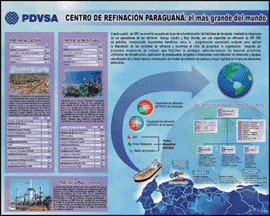
The Largest in The World
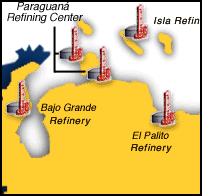
On August 1997 The Paraguana Refining Center was created, in the process of transformation of Petroleos de Venezuela, through the integration of operations activities of the refineries of Amuay, Cardon in the state of Falcon; and Bajo Grande in Zulia state.
The integration of Amuay and Cardón represents a growth opportunity in the refinery sector, for both centers relying on modern installations, which have made way for large benefits.
The Paraguaná Refining Center has an installed capacity of 955.000 daily barrels of crude, which equals 71 percent of the total capacity of refinement in the country and a 33 percent of the international circuit of Petróleos de Venezuela.
History
The refineries of Amuay and Cardón were put in service in 1950 and 1949, by the Creole and Shell concessions, with an initial processing capacity of 60 and 50 thousand daily barrels. With the nationalization of oil, since 1976, these centers of refinement were then operated by Lagoven y Maraven, filials of PDVSA.
The Bajo Grande Refinery, located in the western coast of The Maracaibo Lake, in the Zulia state, was built by The Richmond Exploration Company in the year 1956, then acquired in 1964 by la Chevron Oil Company. In 1976 with the nationalization of oil, it was then managed by The Boscanven company. In 1987, with the rationalization process of PDVSA, it passed to the hands of Corporven and later Maraven in the year 1988.
Presently it processes 15 thousand daily barrels of crude Boscan which travels through oil pipe lines to its storing tanks from the 40 Kilometers route of San José of Perijá.
Thanks to this process, a better performance is obtained from penetration asphalt with exporting quality.
As a solution to production increase and the large reserves of heavy crude, both refineries have made the most important projects of refinement of Venezuela, which are the Modification of Refinery Patterns of Amuay, MPRA (1982); and the Adequateness of the Cardon Refinery project, PARC (1996).
Since October 1995 the interaction of these two centers was set ahead through the projects of interconnection of Amuay-Cardón I (IAC-I), which was made intense in 1996, with the function of the second phase of this project (IAC-II), allowing these to be physically joined through six polyducts for the exchange of olefinas, naftas y gasóleos.
Since then profits have been made through the manufacture of products with a higher commercial value, it also creates more flexibility in the exchange of fluids during periods where the plant is stopped or in situations of contingent activities.


 VENEZUELA