SEO Version


www.ebizguides.com
14
General Information
The Ecuadorian territory was the northern part of the
Inca Empire, with its center in Quito. In 1526 Spanish
explorers reached the coast of present day Ecuador.
The internal fight for succession between Huascar
and Atahualpa decreased the power of the Empire,
facilitating its conquest by Sebastian Benalcázar in
1534. Initially, this territory was part of the Viceroy-
alty of Peru, incorporated in 1717 to New Granada.
Despite the separatist movements, the liberation
army led by General Antonio José de Sucre, got
the lead in 1822. After the victory, the Royal as-
sembly joined the Gran Colombia, of which Ven-
ezuela, Colombia and Panama were also a part of.
In 1830 it became independent, adopting its title as
the Republic of Ecuador. The first president was the
Venezuelan General Juan José Flores, who repre-
sented the interests of the ultra-conservative group.
Introduction
Welcome to the Republic of Ecuador, a fascinating
country located between Colombia and Peru. With
one of the largest concentrations of biodiversity in the
world, it is a forward thinking country due to the changes
being made to improve it’s industries and to ensure its
competitiveness. Ecuador strives to become more
attractive to investors and to provide guarantees for its
entrepreneurs and workers whilst preserving a natural
and priveleged environment.
History
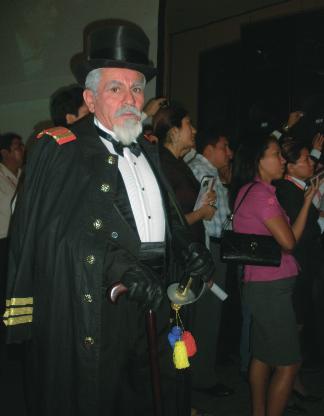
Actor dressed up as Eloy Alfaro
In 1833 civil war broke out between conservatives
and liberals in Quito, which gave way to a series
of conflicts that provoked the creation of dictatorial
regimes. In 1895 the liberal revolution led by Eloy
Alfaro brought him to power, delivering a liberal
constitution during its second term (1907-1911).
Alfaro was killed in 1912 and the country found itself
under the economic influence of the British Empire.
In 1941, after a brief war with Peru, Ecuador
renounced its claims to sovereignty over large parts
of the Amazon, signing the Peace Protocol of Rio de
Janeiro in 1942 which established borders between
the two countries. Many of these borders were
fundamental in preventing further conflict.
In 1972 US companies began to export oil making
Ecuador the second largest oil exporter in Latin
America after Venezuela. In January 1995 Ecuador
found itself in a new armed conflict against Peru.
The root of this confrontation being Cordillera del
Condor, which boasted large deposits of gold and oil.
Thanks to the intervention of the guarantor countries,
Ecuador and Peru adopted the Declaration of Peace
Itamaratí.
In 1998 Jamil Mahuad Witt, the mayor of Quito, was
elected president. Under his rule the conflict with
Peru was finally settled. As a result of price increases,
social protests broke out causing the government
to declare the US dollar as the national currency in
early 2000. policy which brought about further public
protests and general strikes. Mahuad was deposed
by a military coup, giving the government the
power to Vice President Gustavo Noboa Bejarano
due to international pressure. Noboa, however,
continued the process of dollarization started by his
predecessor.
Important dates from 2000:
2001
The exodus of labor (Ecuadorians working in other
countries) emerged as a major source of foreign
income.
It also marked the beginning of the sale of electricity
distribution companies.
Feb. 2
- Noboa decreed a state of emergency after
indigenous uprisings. The Indigenous peoples
closed roads in Cuenca, Riobamba, Ambato,
Cayambe and other places interprovincial transport
in the mountains were in meltdown.
Feb. 5
- Three villagers were killed and more than
80 were injured (including 9 soldiers) during armed
conflicts at Tena and Ambato.
Powered by FlippingBook Publisher