SEO Version


177
www.ebizguides.com
Guayaquil
Guayaquil has become one of the largest and
most important shipyards of America in the seven-
teenth century. Due to the commercial boom that
the city remained in its early years, Guayaquil had
to endure several pirate attacks.
Nowadays, Guayaquil has one of the largest harbors
in the eastern Pacific coast. Guayaquil is ranked 9th
by the Economic Commission for Latin America and
the Caribbean (ECLAC). The harbor was built be-
tween 1959 to 1963. 70% of private exports of the
country goes through its facilities, entering 83% of
imports. The Port of Guayaquil handles 93% of the
country’s container traffic (representing 453 thou-
sand TEUs) and 62% of its total cargo traffic of 5.6
million tons, making it the 13th busiest port in the
Caribbean and Latin America. The Port of Guayaquil
operates 24 hours a day, 365 days a year. Its geo-
graphical situation is:
Latitude 2 ° 16 ‘51’’S
Longitude 79 ° 54 ‘49’’W
The port’s privileged location attracts traffic from
the routes of Asia, the Far East and the Americas,
especially those on the Pacific Coast. It is highly
desirable for the Latin American cargo destined
to cross the Panama Canal toward the east coast
of the continent as well as towards Europe and
Africa.
Thanks to its legal framework private companies
practice without restrictions its port activities. Ec-
uador is engaged in a successful action moderni-
zation of both ports and customs, creating a high
degree of reliability for investments made in the
country.
The port of Guayaquil has an adequate infrastruc-
ture for the development of international trade,
which has optimal means for implementing opera-
tions. The port is providing all services required
by ships and goods through highly specialized pri-
vate operators, under the supervision of the Port
Authority, acting in competition to meet the needs
of demanding users, achieving high efficiency and
cost reduction.
The seaport of Guayaquil is capable of providing
services to all types of vessels, as well as han-
dling and storing containers or any type of dry or
refrigerated cargo.
The main characteristics of the port are:
guayaquil sea port
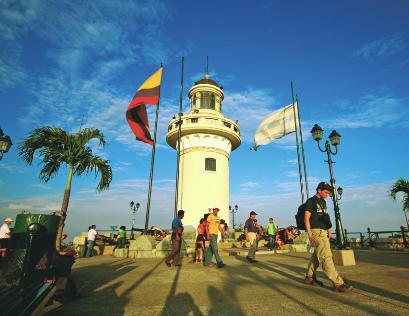
The lighthouseof SantaAna (info@yelagraphics.com)
* Total Port Area: 200 hectares.
* Total length of dock area: 1,625 mtrs.
The piers are distributed as follows:
General Cargo
* Number of moorings: 5 piers
* Overall length: 925 mtrs.
* Width of the pier apron: 30 mtrs.
* First line holds: 4
* Second line holds: 20
* Dangerous Cargo holds: 4
Container Terminal
* Number of moorings: 3 springs
* Overall length: 555 mtrs.
* Width of apron springs: 30 mtrs.
* Container Storage Modules: 4 to 7,500 teus
* Holds for consolidation and deconsolidation of
merchandise: 3 of 7,200 m2 c / u.
* Gantry crane of 40 tons. : 1 crane
* Container Terminals: 2
* Container Carriers (Transtainer): 2
Bulk Cargo Terminal
* Number of moorings: 1 pier
* Overall length: 155 mtrs.
* Storage Warehouse: 1 (30,000 tons.)
* Number of bins: 3 of 6,000 tons. ea
* Pneumatic system for loading and unloading
of bulk: 1
Bulk liquid cargo molasses
* Storage Area: 4,278 m2
* Storage capacity: 30,000 tons.
* Metal tanks for molasses: 3 with 3,200 mt ea
Vegetable oils
* Storage capacity: 240 tons.
Powered by FlippingBook Publisher