SEO Version


www.ebizguides.com
178
Guayaquil
Future Deep Water Harbour
of Posorja
NewAirport in Daular
metrovia - mass public
transportation system
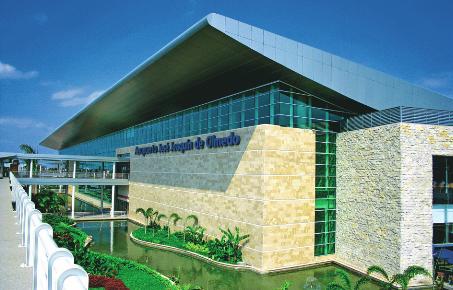
José Joaquín de Olmedo
International Airport
A deep-water port is any port that can accommodate a
fully laden Panamax ship. Posorja is a small village in
Ecuador that lies close from the city Guayaquil at the
delta of the Guayas River, the place where the future
deep water harbour will be constructed. $450mil deep-
water port project will be done by Spanish firm Alianza
Internacional Portuaria (Alinport). The port would be
capable of receiving ships with drafts of up to 15m. Alin-
port aims to attract 12% of the 5M TEUs of cargo that is
currently shipped on the Pacific Ocean, much of which
cannot enter Guayaquil port. The containers arriving at
the future port of Posorja will have to be transported by
land or sea to the Port of Guayaquil for downloading.
The deepwater port project is a key component for
three companies operating in Posorja that process
70 percent of national production and export of tuna.
These are: Negocios Industriales Reales SA (NIRSA),
the largest in the country, Empresa Pesquera Ecuatori-
ana SA (Empesec) and Salica of Ecuador.
The current Jose Joaquin de Olmedo Airport will be-
come saturated when reaching almost 180 000 opera-
In August 2006, the city’s first bus rapid system, Metro-
via, opened to provide a quicker, high-capacity service.
Guayaquil, Ecuador’s most populous city, has achieved
international recognition in the public transportation
sector with its Metrovia system. The Metrovia system is
Aeropuerto Internacional José Joaquín de Olmedo
(IATA: GYE, ICAO: SEGY) is the airport of Guayaquil. It
moved over 2 million national passengers and almost 4
million international passengers in 2010.
The airport opened in 2006, on the same track of the
previous airport but in a new building with 50 thou-
sand square meters of construction. The airport was
awarded by the ACI (Airports Council International) and
ranked first in Latin America and Caribbean by region,
and third place worldwide in airports for less than five
million passengers.
The use of this airport was predicted for the next 10 to
12 years, starting from 2006, or before exceeding the
expectations of the capacity of 5 million passengers per
year. As this already happened it is predicted to build a
new airport in Daular area, 20 kilometers outside the
city, near the highway connecting the cities of Guayaquil
and the coastal resort of Salinas.
J.J. OlmedoAirport (info@yelagraphics.com)
tions per year. U.S. Mitre Corporation (an entity funded
by the United States government and senior adviser to
the Federal Aviation Administration (FAA), which oper-
ates the air traffic in that country), conducted a study in
the area of airworthiness Daular, considered feasible to
build the international airport of three parallel runways, 2
of 3.500 meters and the central of 4.100 meters, sepa-
rated by 1.310 meters, that can last up to 80 years.
According to a study of airworthiness, 2000 daily op-
erations (takeoffs and landings) would be the limit to
reach the final stage in the new international airport in
Guayaquil.
Mitre took into account parameters such as tempera-
ture, humidity, visibility, clouds, rain and thunderstorms.
It was concluded that there are ideal viewing conditions
for landing and takeoff for 99.75% of the time.
Among the advantages of the place, according to the
analysis, is the low wind speed area and soil type. The
soil in Daular is rocky and supports about 21 tons (MT)
per square meter. The best condition is that the site is
surrounded by urban work, unlike the Guayaquil airport.
The forecast is that in 2022 Guayaquil will require a new
international airport, and the first phase of construction
will be in 2019.
Powered by FlippingBook Publisher