SEO Version


www.ebizguides.com
246
Agriculture
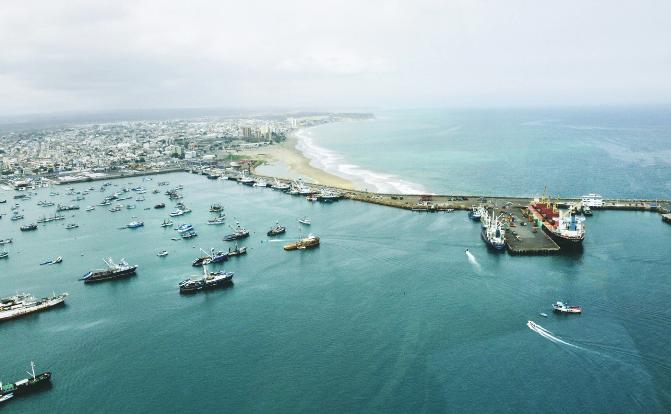
Port of Manta international capital of the tuna
Shrimp trawl fishery
The segment is dedicated to the capture of sev-
eral species of marine shrimp located between 2
and 360 meters deep. The activity is carried out
with 215 boats, registered in 2001. Catches are
ranged between 8 and 10 thousand MT per year.
Artisanal fisheries maritime continent
This fishery considers the following alternatives:
• Fish Collection, which includes the area of inter-
tidal shellfish with the collectors of shells, crabs,
clams, mussels, shrimp, jaibas, shrimp mature fe-
males and larval shrimp
• Coastal Artisanal Fishing that employs boats
that allows to catch demersal and pelagic fish
• Artisanal Oceanic Fisheries, which operates
offshore with vessels capturing demersal and pe-
lagic fish.
The National Fishery Institute estimates that
the total average of landings of this subsector
reached between 30000 and 70000 tons per year
in 2002, of which 63% were pelagic, 29% corre-
sponded to demersal fish and the remaining 8%
to other species.
Galápagos Artisanal Fisheries
The archipelago is located 1500 km away from
the coast of Ecuador and its internal waters are
the islands’ marine reserve, which is added to an
absorbing zone of 40 nautical miles around the
reserve. This fishing involves around 1000 fisher-
men that employ about 367 boats, registered in
2000. The activity is regulated by the Galapagos
National Park and is based on agreements with
the artisanal fishing sector dedicated to fishing
mullet, cod, tuna, lobster and sea cucumber.
Inland water fisheries (freshwater)
There is no reliable statistics on the activity in this
sector, which is mostly handmade and is intended
to meet local needs.
Angling
This activity takes place in coastal waters, espe-
cially in front of La Puntilla de Santa Elena, near
the island of La Plata.
Current status of the industry
Ecuador is a country that is located to the north-
west of South America and its coasts are spread
over 2859 km, including open waters of the Pacific
Ocean and internal waters of the main estuaries
formed by the Guayas River.
The location of the country allows it to be influ-
enced by the cold Humboldt Current and the warm
El Niño Current. Their convergence creates an
ideal environment for the production of a variety
of marine species.
Powered by FlippingBook Publisher