SEO Version



247
www.ebizguides.com
Agriculture
Tilapia’s fish farms
Ecuadorian fishry products
The industrial fishing began in the mid-twentieth
century with catches of tuna and marine shrimp.
Subsequently, it extended to several species of
small and large pelagic (white fish) and since the
70’s began the aquaculture with shrimp farming in
pools in areas flooded by the tide.
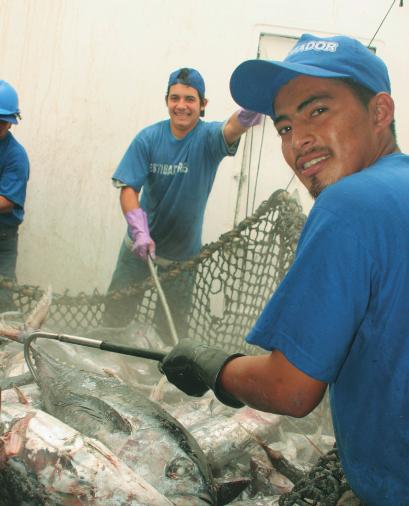
Apart from the powerful and modern tuna industry
in Manta, there is an artisanal fishing that turned
from sail to fiberglass boats with outboard motor.
They contribute to the fishing sector by catching
pelagic and demersal fish , shrimp, lobster, and
a variety of seafood to meet the demand of both
domestic and international markets.
The country’s total fish production between 1990
- 1999 averaged 403,939 tons per year with a to-
tal value of $1 billion USD per year. Although this
production only represents 0.4% of the total world
fisheries, the sector contributed between 3.8%
and 6.3% to the GDP during this period of time.
The maritime sector has important pelagic and
demersal fisheries, being an industrial group in
Ecuador that employs around 400000 people.
There are about 15,000 small boats related to
the artisanal fishing. The industrial fishing fleet
involves 284 fishing boats, which are equipped
with the latest technology helping to preserve the
caught species.
Ecuadorian fishery products are exported in 4
main forms: fresh, frozen, canned or fish meal.
Canned tuna is the main product in this group,
representing 54% of total exports, followed by
pre-cooked loins that correspond to 45%.
The Ecuadorian tuna fleet meets the requirements
of the International Program for the Conservation
of Dolphins regulated by the Inter American Tropi-
cal Tuna Commission, and holds the certification
“AIDCP Dolphin Safe.”
AQUACULTURE
The leading agency responsible for aquaculture
in the country is the Secretariat for Aquaculture,
which promotes sustainable development of the
sector. It manages, monitors, develops and dis-
tributes the aquaculture activity at all levels, from
basic research and technological innovation to
development of human capital and promotion of
products in domestic and external markets.
Ecuador is a privileged country for aquaculture,
due to its soil quality, natural resources and fa-
vorable climatic conditions. This conditions allow
production of white shrimp and tilapia in controlled
and sustainable conditions throughout the whole
year. This activity began in Ecuador about 4 dec-
ades ago.
Sustainable development has made Ecuador one
of the leading producers and exporters of both
products worldwide.
Over 95% of aquaculture in Ecuador is shrim p
farming, followed by cultivation of tilapia, which
has grown considerably over the past five years,
whereas other species (fish and freshwater crus-
taceans) represent a very small percentage.
Freshwater aquaculture has been considerably
developed in the inter-Andean region, mainly with
farms of rainbow trout. Chame cultivation is in
progress in the coastal region.
Powered by FlippingBook Publisher