SEO Version


www.ebizguides.com
250
Agriculture
Ecuador hasanexcellent qualityofArábigoandRobustacoffees
Varieties of the Ecuadorian Coffee
Two varieties of commercial coffee are cultivated
and exported in Ecuador:
• Arabig Coffee: (Coffea arábiga) is cultivated in high
altitude areas, up 2000 metres above the sea level;
plantations are located in the exterior flanks of the
Andean, eastern and western ridges.
• Robusta Coffee: (Coffea canephora) is grown at
400 meters of altitude, in humid tropics, as the ones
found in the eastern Ecuador.
The Arabig coffee is grown in between June and
August and Robusta coffee from May to December;
whilst the coffee gathered in the Galápagos Islands
is grown between December and March.
Soluble Industry
The coffee industry in Ecuador depends heavily on high
technology for the elaboration of soluble coffee, which
guarantees high quality of exported products. The Ec-
uadorian enterprises that produce soluble coffee have
a long international track record, offering credibility and
security to its exterior business partners.
Ecuador not only exports soluble coffee as green coffee
or in beans, but also in other presentations:
• Atomized Coffee (Spray dried). Coffee is roasted and
percolated. Then submitted to drying in heat and subse-
quently to spraying; it is found in powder and amassed.
• Café liofilizado (Freeze dried). Coffee is roasted
and percolated. It is frozen and subjected to a subli-
mation process; this is how a easily dissolved solu-
ble coffee is obtained.
The Ecuadorian processed coffee is marketed in
bulk and in packaging with different commercial
presentations, such as sachets, delta pack, as well
as tinplate and glass packages. These presentations
are sold with both as own brands and with private
labels, depending on customer requirements.
Special Ecuadorian Coffee
Special Coffee is a product that is distinguished by
its special characteristics that guarantee greater
added value, such as:
- specific characteristics of the cup
- agro-ecological areas where it is cultivated
- production technology and processing
- its contribution to the conservation of biodiversity
- solidarity and fair trade principles, which guarantee
a fair price for the coffee grower
In addition, the country offers Specialty coffees,
to delight even the most demanding tastes. In this
range, there are “organic” and “gourmet” products,
as well as “de sombra” and “de origen”: all produced
under strict quality standards, making the Ecuado-
rian coffee competitive at the international level.
Ecuadorian coffee in the World
The Ecuadorian coffee is currently being exported
to 50 countries, among which are Germany, Poland,
Russia, Japan, Colombia, England, Netherlands,
Peru and United States.
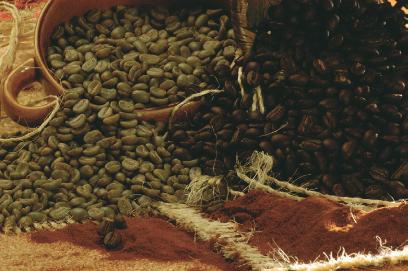
The coffee in the form of green beans or roasted
coffee is exported in sacks cabuya of 60 Kg., whilst
soluble coffee comes in boxes of 25 to 30 kilos, or in
glass bottles, cans and envelopes. It is also exported
as a frozen extract in drums of 55 gallons.
Exports of industrialized coffee have represented
nearly 76 percent of total exports in recent years.
The main destination markets of Ecuadorian coffee
beans in 2009 were Colombia, United States, Ger-
many, Spain, Japan and Chile, among others.
The main Ecuadorian industrialized coffee mar-
kets in the 2009 were Poland, Germany, Rus-
sia, England, Japan, Peru, Turkey, Netherlands,
among others.
Exportable Offer
The coffee crop in Ecuador occupies an area
of approximately 219,000 hectares, of which 68
percent is related to crops of arabica coffee and
32 per cent to crops of robusta coffee. For 2010,
there is an estimated production of 650,000 sacks
of 60 kg.
Powered by FlippingBook Publisher