SEO Version


255
www.ebizguides.com
Agriculture
Palmheart
dry tropical climate and wet tropical climate; that is
why the fruit is grown in the Coastline regions of the
country and in the East, which guarantees the avail-
ability of this fruit throughout the year.
The main variety that Ecuador is exporting is Gold
“Extra Sweet” MD2, which is the world most con-
sumed type (80 per cent of the pineapples con-
sumed worldwide belong to this category). Ecuador
is the second world exporter of this variety.
The producer and exporter sector have formed a
guild in The Association of Pineapple Producers of
Ecuador ASOPIÑA, private nonprofit organization,
whose main objective is the continuous improve-
ment of production processes, based on training
and research activities and aimed at producing fruit
that complies with the most demanding international
quality standards. In case you need more informa-
tion on Asopiña, visit the web page: www.asopina.
ecuador.org
Development
Currently, Ecuador has 3.300 hectares of crop of
Pineapple, located mainly in the provinces of Los
Ríos and Santo Domingo de Los Tsáchilas. In 2009,
$44.19 million USD were exported, representing an
important income of foreign currency for the coun-
try. Its participation in non-traditional exports for the
mentioned period was 1.2% and 3% in the GDP of
agricultural products.
Exports and main markets
The country has exported 99.465 tons in 2009. Ec-
uador exports to around 42 countries in the world.
Within the most important markets are the United
States as the main market with a 25.87%, Spain,
with a 17 per cent, Chile 13.48%, Netherlands
12.90%, Russia 10% and Italy 6.94%.
PALMHEARTPROFILE INECUADOR
Ecuador is the first palm heart exporter in the world.
The Ecuadorian palm heart is a very popular prod-
uct in the world market due to its excellent quality.
Advanced logistic processes ensure that stems are
processed in an optimal state of freshness.
¿Why import Ecuadorian palm heart?
Favorable geographical and environmental condi-
tions in the tropical Ecuador cultivations, such as
light, humidity and stable temperature, among others
Palm heart is a very exotic “gourmet” product which
is directed towards health-conscious consumers. It
is rich in fiber, iron and calcium and contains no cho-
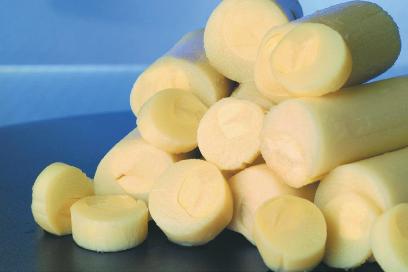
lesterol. Palm hearts are smooth, ivory-colored, with
firm texture and delicate flavor. They can be used in
salads, ceviche, cocktails, and even salted or fried
as a main dish.
Development of the sector
Palm heart has been cultivated in Ecuador since
early 1987. The development of agribusiness,
dedicated to the canning process, began in 1991.
This sector has experienced steady and sustained
growth, becoming one of the most representatives of
the country’s traditional exports.
Main producers and exporters
Ecuador has about 15,500 cultivated hectares of Palm
heart. The production is concentrated in tropical and
subtropical areas, such as LagoAgrio, Coca, Tena, Ma-
cas, Zamora, Esmeraldas, San Lorenzo, Muisne, Santo
Domingo de los Colorados, La Concordia, Nanegalito
- Puerto Quito, Bucay.
The main exporters of Palm heart are: Inaexpo, Proce-
consa, Protropic, Sipia, Ecuapalmito and Ecuavegetal
Ecuadorian Palm heart export firms have international
certifications such as:
- International HACCP Certification.
- U.S. FDA approval.
- Kosher for Israel and the United States.
- Certificate granted by the BASC (BusinessAnti-Smug-
gling Coalition)
Export markets
Ecuador is among the most important exporters of
canned Palm heart in the world. According to the
Central Bank data, at the end of 2009, exports of
palm rounded $54 billion USD and 22,946.20 tons.
Powered by FlippingBook Publisher