World Investment News | Create account
| Share This! |

|

|

|
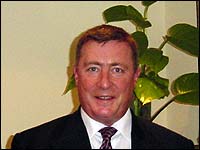
So Mr Curran, with the beautiful location of this hotel it must be the most important hotel in Cairo or one of the most important. Could you give us a brief introduction, a presentation of the hotel. And since when is it operating?
Well, thank you very much. Certainly you are quite right; we are privileged with our location. It is probably, not exaggerating to say, is one of the premiere locations worldwide. Being located right next door to the great pyramid of Giza and having wonderful views from the hotel on to the pyramids themselves. The hotel in its current format is only ten years old. It was reopened and then became a Meridien Hotel some eight years ago. So, ten years in its current format. It is the largest hotel within this area, within the Pyramids area, with some 550 rooms and has an extensive range of food and beverage and leisure activities. Is basically a resort although its located in Cairo, although in the periphery of Cairo. So it’s somewhat of an open resort hotel. With leisure making up some 85% of our business and the remaining 15% being corporate.
Will the corporate business be more important in the future?
I think the leisure market will always be our number one market. There may be some slight shift one way or the other depending on how the economies of either Egypt or our main feeder markets are performing. But we will fundamentally be a leisure hotel. We are a resort property.
So this belongs to the Le Meridien chain since 8 years ago…
The hotel actually belongs to a private owner but it is managed by Le Meridien.
And the private owner is Egyptian?
The private owner is made up of a number of people but the primary one lives in Egypt.
I see. And you are the General Manager since when?
I’ve been here now going up for seven years. Nearly seven years.
And you know for how long are you going or do you want to stay?
Oh; my wife wants to stay a long time, so I am probably staying a long time. Certainly no plans to move.
Within the chain of Le Meridien what degree of, not independence; but autonomy do you have in operating the hotel?
You want to talk about advertising or you want to talk about operating?
No; operating. The day to day business of the hotel.
Total. Total autonomy. I mean, obviously we have the standards within which we have to conform. But those standards tend to be minimum standards. We also have some guidelines in terms of advertising and marketing, which are fairly strict, but in terms of operations we are… one of our guiding forces is that we tend to have, to place a very high importance at local culture. So is how we operate our hotels, difference from location to location depending on the local environment and local culture.
As my colleague said, we just arrived and we are getting familiar with the country and the economy. We know that tourism is one of the main engines of the economy in Egypt and from what I have read, 15 years ago in 1991 there was a huge privatization process. But still, since this is so important for the Egyptian government, how is the relationship; what is exactly the role of the government towards tourism? Is it a complex relationship?
A: It is actually very straight forward. You are quite right in saying that one of the main platforms of the economy is tourism and certainly will be going forward. It basically falls down to three categories: oil & gas, telecom and tourism. And the one with the greatest propensity for growth, unquestionably, is Tourism. The government has been very proactive in terms of the generic marketing of the destination globally. Probably the most visible manifestation of that is CNN, in what’s been going on vis a vis the generic marketing of Egypt on that for the last eight, nine, ten years. Certainly become more prevalent in the last few years with the Red Sea Riviera and the different aspects of it to show both. I hope. You don’t watch CNN? It’s all the time, the advertising on Egypt. With the Aida music in the background. May be you’ve seen it but it hasn’t registered. I am sure next time you see it… you will say, this was what this guy was talking about. I mean; millions and millions of dollars spent there, rising up the awareness of the destination internationally. So they have been very active and in addition to that there has been a lot of improvement in the infrastructure, which was badly needed. The infrastructure within this country was very, very poor. There are still some examples of that left. One of which you will have definitely seen which is the airport when you arrived. But I am very happy to tell you that all of the inner airports in Egypt are either brand new or have been completely overhauled in the very recent past. And they are currently building the replacement for the airport that you arrived into, which will open up within two years and will be of the same size as Dubai, for example. So that’s the airports; the road network has been dramatically improved. There is still some work to do but it’s ongoing and it’s been huge improvement in the last four; five years. So we can see it happening. A lot is going on. Still lots to be done but very definitely it’s on the move.
So there is an exchange of ideas. They listen to your demands and your needs…
Very much. And we have regular meetings with the Minister of Tourism, for example.
Mr El Magrabi.
Yes, Magrabi.
He is prepared to listen…
He is one of the most successful private entrepreneurs in tourism in Egypt over the last 15 to 20 years. So he is only become a minister recently. So he is very…
He was a minister before? Another ressort?
No. He is managing director of his own company. Owner of his own company. A very successful company, with many hotels. So he very much sees things from the point of view of industry and he is very tuned to our needs and the needs of the country as a whole as far as tourism is concerned. He is done it very well in its ministry.
And the largest amount of visitors to this hotel are from?
UK. The number one market is the UK. Basically the main market for us is Western Europe of which UK is number one. Followed closely by Spain and Italy.
Not Germany?
Not Germany. And then comes probably Germany after that, before France.
And then France…
Yes.
And what about the Americans?
Before the Americans, we have the Far East and the Middle East.
I heard that the people from the Near East have been sort of neglected?
You are talking about the Gulf?
Yes.
Not at all.
I read this in the newspapers.
No, no. I mean, basically quite the opposite is true, actually. And if you think about what I’ve been saying you find this very logical. Following the September 11th issue and the subsequent troubles that we’ve had in this part of the world it was very quickly recognised by Egypt that perhaps the people in the Gulf would not want to travel to America or Europe. And that was a big advantage for us. Competitively. So we are targeting that market very very strongly in the last two to three years. The market down there specifically exists during the summer because of the heat down there and they want to move somewhere. So although that they historically they move to the States for two or three months or to Europe, a lot of them came to Egypt in the last two years. It’s a growing market.
Let us talk a little bit in general about this country, not only the sector, we see that a lot of things have been going on apart from the elections, still the economic reform process and then the important role that Egypt is playing in the region and now with the specific relationship and the Partnership Agreement with the EU. How do you see the future of Egypt. President Mubarak is now 76 years old. Do you think that they are going to advance on this path of reform?
I’ve been living here for 7 years now. I have got a reasonable insight on what is going on. And I am absolutely convinced that they will continue down the path of political reform. I think that it will be at a managed pace. I think that there is no desire within the government to risk any negative effect as a result of rushing it. And so I think they are totally committed to the path they have chosen. But I think they want to do it at the pace that they feel is right for the country. And personally I think that is sensible. We have seen instances of political reform in the last decade, decade and a half, which have been disastrous. Because in hindsight it had been done too quickly. I mean, Russia is one example. Where the whole thing unravelled overnight. The other extreme is China where they are managing it at a very very slow pace. But they will get there. And they won’t have the problems that Russia had in terms of the economic turmoil in terms of the collapse of social services, etc., etc., the rise of crime, the very dubious mega-deals that were done at the cost of the overall economy. So I think this country has seen both sides and it will choose its own path.
Taking into account that Egypt is such an important country within the Arab world, do you think it could be a role model for other Arab countries showing that reform is possible?
I don’t think Egypt necessarily is setting out to be a role model or wants to be a role model, I think there are other powers in the world that are hoping it will be. I don’t think for one moment that that is why they are doing it. But indirectly it may be an indirect result.
Let us come back to this hotel and to yourself. What do you think you and your management have achieved in these years and what do you want to achieve next?
Well, I think we have got a much higher guess satisfaction ratio. In fact we are now number three in our company worldwide. Which certainly was not the case years gone by. And our objective is to keep heading very very high levels of guest satisfaction. Generate more return business. And continue to improve the product and the quality of our service.
Is there a specific message you would like to transmit to our French readers in Europe?
Come and stay in our hotel.
That’s a good message. Thank you very much fir the conversation.
Not at all. Is my pleasure.