World Investment News | Create account
| Share This! |

|

|

|
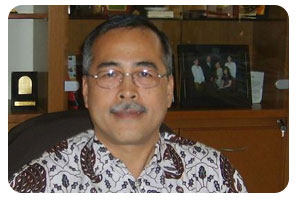
Dr. Siregar has studied in one of the best public institute in Indonesia and increased his knowledge and experience in France and several other countries such as United States. He has been a pioneer in implementing what works in the western countries to Indonesia such as research centers.
“Come to Maranatha and you will study culture, tourism and fashion with students coming from many different regions and ethnic groups of Indonesia.”
The university was initially made up of only one faculty and reached eight of them today. Could you give us a presentation of the different faculties and courses the university has to offer and what is the Institute mainly recognized for?
We started first with the faculty of medicine, followed by the faculty of engineering, the faculty of psychology, the faculty of letters, the faculty of economics, the faculty of information technology, the faculty of art and design, and recently the faculty of law. We have 25 study programs for the bachelor degree, and three for masters’ degree. In which concerns the faculty of medicine, we have study programs of dentistry, bachelor of medical, and a professional doctor. In the faculty of engineering, we have study programs of civil engineering, electrical engineering, industrial engineering, and computer engineering. For psychology, we have bachelor of psychology and professional psychology. For the faculty of letters we have an English, Japanese, and Chinese department with study programs of S1 which lasts around four years, or Sarjana Strata Satu, and D3, or Diploma Tiga, which lasts three years. In economics we have study programs of management and accounting and professional accounting. In IT we have study programs of system information, information technology, and the Diploma 3 program. In arts and design we have visual communication design study program, fine arts, and interior design. We also have the Diploma 3 program for design and arts. As the faculty of law has just been set up, we only have one study program. We have the masters’ degrees in management accounting and in psychology. We are well recognized for our faculty in medicine in the whole country as we are one of the oldest institutions in Bandung and in West Java. We also have good accreditation in the electrical engineering, in psychology, and each year we have more and more students applying for interior design and the of visual communication design.
An important factor when students are making their choice in higher education are the campus facilities. Could you please tell us more about it?
We are currently working on the improvement of our Internet facility and we have recently finished building a fifteen floors building we called Graha Widya Maranatha with around 5 ha so it will provide us with enough space for 10 years. We have also a number of laboratories. Unfortunately we cannot provide them with a sport center; we only have an indoor basketball, climbing wall and badminton field because we don’t have enough space. We have to build vertically because we are surrounded by inhabitants. We are trying to find somebody in the surrounding who would sell their land and we are also looking for a space dedicated to martial arts. We also provide medical services, a polyclinic, and a large canteen. However we can not provide them with dormitories, the good thing is that neighborhood had benefited from our student in terms of rents as they and the professors are renting the rooms nearby.
The strength of a university is also its capacity to bring its students to become government officials and business leader. To what extend do you see your university as an engine of the development of the country?
Maranatha is an engine of the Indonesian development as our students are the ones who really deal with the day-to-day activities in the economy, with the investors, either national or foreign investors. We provide good quality human resources to feed and handle the national production. We are confident we have a great future for our campus. We have long term plans spanning until 2015. Maranatha students are very high potentials who greatly contribute to the country in terms of graduates participating in the society, in the economy, developing the country. During their studies our students becomes employees since they participate in the research we conduct with the industrial sector. They get to be known before they graduate.
It is stated on your website that your mission is to carry out the mandate of the Three-Fold Purpose for a Christian Higher Education Institution, that is, “first in knowledge, first in service, and first in faith “. Could you tell us more about the main strengths and competitive advantages compared to other Universities and Institutes of Indonesia?
We are a Christian university, this unique identity is our strength and we stated that we are developing Christian values. Applied to education it means that we are promoting three values: integrity, care, and excellence. The foundation of Maranatha is supported by two churches, the Indonesian church and the Sudanese church from West Java. These churches are represented in the foundation which gives guidance to the university. Since we are supported we need to report at least annually concerning our objectives and our obstacles. We also need to emphasize that despite our unique identity as a Christian University, we are very open and tolerant toward other religions and around 30% of our students are from other religions. We have some wealthy students and some from the lower classes who got the scholarship thanks to the church. We have students from Java, North Sumatra, South Sumatra, Riau, Kalimantan, Timor, Sulawesi, Maluku, and Papua but the majority are from West Java. We have various ethnic groups, and different religion representatives, and we are sensitive to the difference. We have to accept all human beings and Jesus Christ gave us the example in the story of the Good Samaritan. We have programs that send our students to face real life problems in the countryside, such as the medical students who have to do community services. Usually this takes place in the rural areas in the northern and southern part of West Java. They learn to survive as a doctor without modern but only limited available facilities. That is the strength of Maranatha: we serve people in a simple way. We have a network with different regions in Indonesia, such as with Bali. In the Gianyar regency we cooperate on health tourism, with our faculty of arts and design. We also cooperate with the health survey in Bandung, West Java; we are in our initial steps to cooperate with Nias and Seran in Maluku; we have established cooperation with Karo regency in the north of Toba Lake, North Sumatra. We set up a college there with some students and professors from Karo to teach the local residents for two years. When they have graduated they can find better jobs in local industries, or they can continue here at Maranatha for a four years degree. Through this program we can contribute to the interests of our people. We got the idea from the US community college to keep educating the local people, community based, and we want to multiply them. There are not many universities that have done it here but in the US they have done it for perhaps 50 years. Since Maranatha have 17,000 alumni, they can help Maranatha in the recruitments of new employee from the new graduates from Maranatha.
It is a primer concern for many institutes today to have international partnerships with other universities. Could you please elaborate on international partnerships MCU is involved with?
Our professors are going to other countries such as the US, Australia, China, and Taiwan to graduate. We have some professors from Philippines and Korea in electrical engineering. We are a member of United Board for Christian Higher Education which provides us with scholarships for our lecturers; we are affiliated with CCCU, Counsel of Christian Colleges and University and ACUCA, Association for Christian University and Colleges in Asia. Our professors also go to Singapore regularly for the art and design faculty. We have cooperated with Liberty University in West Virginia and with universities in Ohio, in Texas and some universities in China. They are interested in the cultural aspects and we are keen on teaching about medicine, engineering. It is also a difficulty for us to get collaborations with western countries in engineering as they are much more advanced than us, so we can only send one or two of our talented students to be post graduates there. We are also planning to develop our joint researches.
Sine you are the expert on education, could you please give us an analysis of the Indonesian tertiary education sector? (UNESCO Institute of Statistics)
In Indonesia, we have around 3,000 universities or higher education institutions, 60 or 70% are public and the rest are private. The government is willing to conduct mergers between the smaller institutions in order to become stronger. It was stated that almost one third of the government’s budget has to be allocated to education and we are expecting funding. We already have around three billion rupiah granted for three years dedicated to research, community services and also for the students. We dedicated one billion rupiah this year to research but we still have to upgrade ourselves to pass the competition accreditation board. We are included in the 50 most promising universities in Indonesia and as the criteria are getting tougher, we do our best to stay in line with those criteria and remain in that list. We also have 70% of English speakers among our students and we truly believe that it is a privileged group that in the next 15 – 25 years will be leading the economy. We have now 14,000 students, and there are around 4,000 students graduated each year. In 1965, we started with the faculty of medicine, but today many students come from entrepreneur family highly involved in the Indonesian economy.
During the visit of US State Secretary Mrs. Hillary Clinton, she emphasized on the need of more cooperation in higher education and exchange programs between Indonesia and the US. What is your opinion and how will MCU benefit from better relations with the US?
We would have an easier access to American faculties and their teachers. Our faculties would be able to have post graduate or post doctoral in the US. We would multiply joint researches from which we would benefit a lot since we do not have as many facilities as the US. We are also open for all funding opportunities and for our students to be exposed to the global environment, to a different culture, to a different way of thinking and different way of life. The publications will also be useful because every country has their own unique culture. For example there are some problems in other countries that the American do not have, but they can contribute with their knowledge and facilities to help solve these. For us, it is also important to reach the international standard in education. Besides the cooperation with the US, we are also eager to learn more about their best practices.
Our readers are also interested in the person we interview. Could you please tell us more about your personal background?
I graduated from ITB in 1975; I then went to study in France. I also had some experiences in consulting in different countries, such as the US. I then taught at ITB from 1981 until today. I got a research fellow post at the Delft University of Technology in 1990-1991. Three years ago, I started supporting the department of coordination of energy and mineral resources to monitor the oil and gas production. At ITB I led two research consortia, and I want to do the same at Maranatha with OPPINET, Optimization of Pipeline Network, and OGRINDO, Oil and Gas Recovery for Indonesia. There are nine participating companies in OPPINET, while OGRINDO has seven contributing companies.
Could you please tell us more about what you consider as your biggest career achievement?
My main achievements are those two researches. OPPINET has been established nine years ago, and OGRINDO six years ago. It is not new in the US and Europe, as it has been established almost 40 years ago. Industry has always had problems, but no time. Companies have money, facilities, data, information, but they do not have time to solve the problems. The university has specialized professors and students who have the time and the motivation. I almost just copied that, but it took a while to implement it in Indonesia.
What would be your Final message to the readers of New York Daily News and the visitors of www.winne.com?
I welcome all the Americans and all the others citizens to study at Maranatha Christian University. We have all the various cultures of Indonesia and at this university we are studying tourism, culture, and fashion and jewelry design. We are eager to develop further cooperation with other countries like the US and other countries in the world. We have also many people represented in Maranatha from various regions in Indonesia and you will find many different ethnic groups, so please come to Maranatha.