Sector Structure
 |
Sonelgaz's monopoly on electricity distribution,
generation and transmission came to an end in January
2002, when new legislation was passed to open up
the gas and power sectors. Under the terms of the
new law, independent electricity and gas regulatory
bodies will be established during a three-year transition
period ahead of the sale of a 30% stake in the company.
The sale will herald the opening-up of the electricity
and gas sectors to private investment, and Sonelgaz
is also to be restructured during the transition
period into two shareholding companies - one to
cover electricity generation and supply, the other
responsible for gas distribution. The regulatory
bodies will ensure basic technical standards and
fair competition. Sonelgaz had previously been given
permission to negotiate build operate own (BOO)
deals with foreign operators.
The first such project calls for a 2,000 MW power
station to be built, 400 MW of which would be purchased
by Sonelgaz for domestic supply with the remainder
to be exported. Work is progressing on joining the
power grids of Libya, Tunisia, Morocco and Algeria.
Sonelgaz will retain a monopoly on the domestic
transmission network. The proposed BOO schemes have
so far met with some interest from foreign investors,
but companies have been awaiting clarification of
the legal framework under which the project would
operate before committing to any deal.
|
Generation |
Algeria has a current electricity generating capacity
of approximately 5,000 MW with demand growing at
5% annually. The state-owned utility Sonelgaz has
a monopoly on electricity generation which is now
set to end following a decision to encourage build-own-operate
(BOO) schemes. The decision to open up the generation
sector to foreign investors (most likely through
partnership with Sonelgaz) came in 1998, against
a background of falling government oil revenues
(due to the price slump).
|
Renewables |
Sonatrach set up a renewable energy joint venture
company with Sonelgaz, and the agricultural food
group Semouleries Industrielles de la Mitidja (SIM)
in July 2002. The new company, which is jointly-owned
by the three companies (Sonatrach - 45%; Sonelgaz
- 45%; SIM - 10%) will be called New Energy Algeria
(NEAL), and will be tasked with developing photovoltaic,
wind, solar and biomass energy production within
Algeria.
|
Transmission, Distribution and Marketing |
Transmission, Distribution and Marketing
Sonelgaz was made a joint stock company in 1999
and was split up under the terms of the 2002 power
law. The move should enable the company to seek
alternative sources of capital and form partnerships.
The government has taken a strategic decision to
make Sonelgaz more competitive, but has stopped
short of full power-sector privatisation, with Sonelgaz
to retain a monopoly on distribution and transmission.
Sonelgaz and Sonatrach announced an agreement to
set up a joint company to explore investment opportunities,
foreign and domestic, in the electricity and gas
sector. The agreement indicates Algerian state-owned
firms will seek wider commercial opportunities.
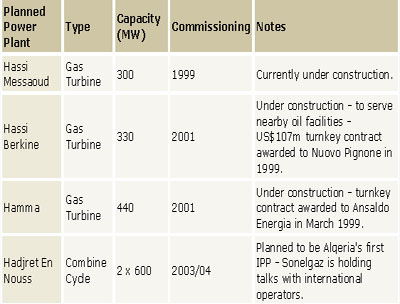
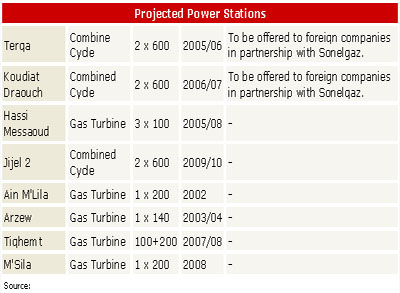
The announcement of several generation projects
(see table below) open to foreign investors has
so far met with little interest from foreign investors.
Legal and implementation clarifications have been
sought by companies before they will seriously consider
the projects. Sonatrach has already awarded the
first privately-funded power plant contract to Nuovo
Pignone for the construction of a 330 MW gas turbine
plant at Hassi Berkine.
Sonelgaz opened technical bids submitted for the
construction of a 2,000 MW independent power plant
(IPP) at Skikda (Hadjret En Nouss), on 31 January
2001. The terms of the IPP will see 800 MW of power
being purchased by Sonelgaz for domestic consumption,
with the remainder targeted for export to southern
Europe, to be marketed by Sonelgaz and the winning
company. The transit of electricity to Italy, France
and Spain may involve the construction of a direct
undersea link, but transit through Tunisia and Morocco
has not been ruled out. Five companies eventually
submitted technical bids for the US$1,500m-US$2,000m
build operate own (BOO) project: Spanish company
Endesa, Enelpower of Italy, Electricite de France,
AES corporation of the US and SNC Lavalin from Canada.
Commercial bids will then be submitted once a feasibility
study into a power link to Spain has been completed.
The strong backing for the project from the World
Bank has boosted the confidence of the developers.
Table
Planned Power Stations
Table
Projected Power Stations
(Make
a click here)
Excellent demand for alger energy 2003
A very competitive and promising business environment
on the Algerian energy, petrochemical, mining and
electricity market leads to an excellent demand
for alger energy 2003. With revenues of about US
$ 20 billion, this sector creates 35% of the Algerian
GDP, 97% of export revenues and 65% of the overall
state budget. According to the Algerian ministry
of energy and mines, huge investments are being
realised during the years 2000-2010. US $ 22 billion
are being invested in the petrochemical sector alone,
and US $ 12.2 billion in the field of electricity
and the distribution of oil and gas.
On the Algerian gas export strategy, Neil Ford writes
in 'Oil Review Middle East', Issue Two 2003:
'Algeria is ideally located to make the most of
the EU's liberalised gas markets. A massive 90 per
cent of all Algerian gas production is already exported
to the European Union. The Algerian government has
set about restructuring its energy sector. The downstream
gas and power sectors have already been liberalised
through legislation passed in February 2003, which
allowed for independent power producers (IPPs).
Foreign oil and gas companies remain enthusiastic
about the planned reform. The nuts and bolts of
Algeria's gas export strategy are impressive. The
country possesses the seventh biggest proven gas
reserves in the world at 159,700 billion cubic feet.
Algeria is firmly in the driving seat when it comes
to making the most of increasing EU demand. It possesses
the longest established LNG sector, is the best-connected
North African country to Europe via pipelines and
is geographically the best located. With the current
reform and liberalisation of the country's energy
sector making good progress, the government can
look forward to growing gas revenues, which should
help reform the rest of the economy.'
On this background it comes with no surprise that
the demand to participate at alger energy 2003 is
excellent. UBI France, the French Agency for International
Business
Development, have already registered with 180 sqms
for an official French pavilion. A Russian and Ukrainian
pavilion at alger energy 2003 is being organized
by Negus Expo, Moscow and an official Canadian pavilion
is put together by the Canadian embassy in Algiers.
Apart from those official group participations,
many individual exhibitors, who participated at
the launch event of alger energy in 2002 with smaller
stands, are now showing off, such as ABB and Schneider
Electric.
Of course Sonatrach and Sonelgaz are again in with
huge stands as well as AEC, Aksa, Amerada Hess,
Dragados, Gaz Inter, Great, Groupement Transformateurs,
Solar Turbines, Siraga, Stroytransgaz, Vatech, Vectra
and many others.
With his letter of 3 March 2003, the minister of
energy and mines, Mr. Chakib Khelil officially puts
alger energy 2003 under his auspices and invites
"all of our partners to participate at this
important event." "The prospects for business
in Algeria are very promising", writes the
minister and sees alger energy 2003 on a good way
to become "the most important annual gathering
in North Africa on energy, mining, petrochemicals
and electricity."
The 2nd international energy, mining, petrochemical
and electrical engineering trade fair of Algeria
- alger energy 2003 - is scheduled to take place
at the Palais des Expositions, Pins Maritimes, Algiers
from 28 September - 01 october 2003. alger energy
is again organized by fairtrade, in close cooperation
with the Algerian ministry of energy and mines and
with Safex, the leading Algerian trade fair organizer.
alger energy 2003 will again be the best platform
for all of the leading players in the Algerian market
to introduce new products, to network with traditional
customers and to make new business contacts. |
alger energy 2003 is
held in conjunction with the 10th Mediterranean
Gas Conference, which is held at the Hilton Algiers
on 30thSeptember and 1st October 2003, Day 3 and
Day 4 of alger energy 2003. This conference is organised
by Overview Conferences in association with Sonatrach
and it also enjoys the patronage of the Algerian
minister of energy.
ITOCHU Corporation and Ishikawajima-Harima Heavy
Industries Co., Ltd. (IHI) have jointly received
an order for a large-scale desalination/power generation
plant from Kahrama SpA, an Independent Water and
Power Producer (IWPP), as the first private business
in Algeria, and a contract was signed in Alger in
the presence of Mr. Khelil, the Minister of Energy
and Mines. The amount of contract is equivalent
to about 40 billion JPY. The contract is a full
turnkey contract which includes the engineering,
procurement, construction, installation, and performance
test of the plant. The plant will be completed by
the end of June, 2005.
Kahrama SpA, owned by BLACK & VEATCH and ALGERIAN
ENERGY COMPANY (a joint venture owned by the Algerian
state-own companies, SONATRACH and SONELGAZ, on
a 50-50 basis) will construct the first large-scale
desalination/power generation plant in the Arzew
industrial zone which is located in the vicinity
of Oran, the second biggest city in Algeria along
the Mediterranean sea.
This project includes construction of natural-gas
power generation facilities having an output of
320,000 kW, and facilities to desalinate seawater
using exhaust heat from the power plant (daily production:
approx. 88,000m3). It is decided that SONATRACH
and SONELGAZ will draw all output of water and electricity
over the next 25 years. The project aims to increase
the output of power generation in Arzew, which serves
as an industrial base in Algeria, and to replenish
water shortages in Oran caused by its population
increase and low rainfall, while using water as
industrial water.
In 1982 and 1998, ITOCHU and IHI constructed world-class
LPG Complex (annual production: 6-million tons)
in the areas adjacent to the construction site in
the Arzew industrial zone. Further, IHI has a track
record of supplying 20 desalination plants, as well
as power generation facilities, throughout the Middle
East. The IHI's experience leads to the order this
time.
Establishment of many IWPPs and desalination plants
are now being planned in the Middle East. Both companies
will keep focusing on the business activities in
this area.
|
Project Outline |
1. Client Name: Kahrama SpA
This company is a JV, 80% owned by BLACK & VEATCH,
and the remaining 20% owned by ALGERIAN ENERGY COMPANY
(AEC).
*AEC is an electric power company owned by the Algerian
state-own hydrocarbon public company, SONATRACH,
and state-own electricity public company, SONELGAZ,
on a 50-50 basis.
2. Site/Use:
Arzew industrial zone (about 350km westward from
Alger)
Meeting the demand for water and electricity in
various plants in the Arzew industrial zone and
the demand for water for civilian use.
3. Project Outline:
Contract Content: Full turnkey contract which includes
the engineering, procurement, construction, installation,
and performance test of the desalination/power generation
plant.
table
4. Competitors:
SNC-Lavalin of Canada and Enelpower of Italy.
5. IWPP:
Independent Water and Power Producer
THE 10 TH ANNUAL MEDITERRANEAN GAS CONFERENCE
IN ALGIERS
30 TH OF SEPTEMBER -1ST OCTOBER |
Introduction
Overview Conferences cordially invites you to attend
the 10th Mediterranean Gas Conference.We are delighted
to announce that this conference will be held in
Algiers, under the patronage of Dr. Chakib Khelil
and hosted by SONATRACH. The conference promises
to be a landmark event and the choice of Algiers
as a location reflects the central role that Algeria
continues to play in the rapidly changing and developing
Mediterranean gas business.Top level speakers from
all the key players in the Mediterranean industry
will meet in Algiers, to share information and debate
the future for the most exciting and varied gas
region in the world.To receive further details about
this important industry event: Email: events@economatters.com
or contact Kate Wright on Tel: +44 (0)20 7650 1402
Day Two - Wednesday 1st October 2003
Working Breakfast: Topic groups
Breakfast will be arranged in groups which will
discuss special themes. We will nominate and publicise
three topics but also invite new ones from delegates
Streamed Conference Sessions
Delegates have the choice of two conference streams
for the remainder of the morning
STREAM 4A: Institutional and Financial Aspects
Chairman:Khaled Boukhelifa
Director General, Ministry of Energy & Mines
Algeria
The European Union's programme for gas: security
of supply and the progress of liberalisation
Speaker from European Commission
STREAM 4B: Gas and Electricity Markets in Europe
and North Africa
Chairman:Aissa Abdelkrim BenghanemSonelgaz
The Algerian gas and electricity markets: demand
growth and market liberalisation
Madjid OthmaneDirector of Regulatory AffairsSonelgaz
How producing countries trade with liberalised
markets
Mr Abdullah Hussain SalattSenior Advisor to the
Minister of Energy and Industry, Qatar
Industry structure: the moves of the main players
David DrurySenior Associate, Gas Strategies
What role should international upstream companies
play in gas development?
David WalkerPresident, UK NA and ME Development
and Operations, BHP Billiton
How Mediterranean gas and power projects can
compete for international project finance:
Nobuyuki Higashi, Japan Bank for International Co-operation
- JBIC
Egypts Natural Gas Strategy: Transportation and
Treatment
Mahmoud LatifChairman, GASCO
How we will achieve the liberalisation of the
Turkish Gas Market
Yusuf GunayChairman, EMRA, Turkey
The pivotal role of the French market in southern
Europe gas and electricity
Speaker from Trading & Marketing, TotalFinaElf
The Iberian market: prospects for gas-fired power
generation
Pedro MoraledaDirector of International Relations,
Gas Natural
The Italian gas and electric ity markets
Speaker from Edison
Panel Session:
What are the lessons and key messages of the conference?·
Chairman: H.E. Dr. Chakib Khelil, Minister of Energy
and Mines, Algeria · Jean-Marie Dauger, Vice
President, Gaz de France · EU Representative*
· Ali Hached, Sonatrach · Aissa Abdelkrim
Benghanem, Sonelgaz · James Ball, Chairman,
Gas Strategies · Mr Abdullah Hussain Salatt,
Senior Advisor to the Minister of Energy and Industry,
Qatar
Mediterranean Policy Roundtable
Chaired by Sylvie Cornot-Gandolphe of the IEA
Delegates who are staying over in Algeria on Wednesday
night will have the opportunity to participate in
a roundtable which will explore the role of gas
in international policy in the Mediterranean. Members
of the diplomatic community in Algiers will also
be invited to the event, which will consider the
following themes: · Security and diversity
of supply · International trade and open
markets · Commonality of interest between
suppliers and buyers |





 Previous