146
Real Estate & Construction
Property
Dev
el
opment
In recent years, favorable socioeconomic factors
and contemporary developments have boosted the
commercial and residential property market, which
have attracted a large percentage of buyers from
South Africa. The development of the financial sec-
tor, particularly with respect to home loans, along
with increasing incomes has also made property
ownership more affordable to many citizens.
Encourag
ing
Commercial
Dev
el
opment
As of 1 January 2010, VAT has been charged on the
sale of commercial properties. This has had a posi-
tive impact for developers, as they are now entitled
to reclaim input VAT on construction expenditure on
a monthly basis. At the same time, they only pay out-
put VAT at the time of sale. This initiative has encour-
aged further development of commercial properties
and related infrastructure. It has also reduced the
cost of buying and leasing commercial property.
Publ
ic Priv
ate Partnership
The government has recognized its inability to suf-
ficiently fund complete infrastructure development. It
is with this in mind that the government is willing to
accept private sector financing under PPP arrange-
ments. There are a wealth of opportunities available
in road works, building construction, and in the cre-
ation of lodging and conference facilities.
OVERVIEW
Zambia’s economic development heavily depends
on the state of its infrastructure—particularly its road
network. This is especially critical for Zambia as it is
a landlocked country, where trade with the Southern
African Development Community (SADC) and the
Common Market for Eastern and Southern Africa
(COMESA) regional blocs depend on the existence
of effective regional and internal road networks.
The sector has performed quite well over the past
few years. Construction activities have been driven
predominantly by commercial and residential build-
ing developments and the development and con-
struction of new mines.
As of 2011, construction activities were heav-
ily focused on the rehabilitation of roads across the
country, the development of a new tourism zone in
Livingstone, and infrastructure to support the estab-
lishment of government initiated Multi-Facility Eco-
nomic Zones. Investment in social infrastructure has
been made via the construction and rehabilitation of
health centers, district hospitals, classrooms, and
universities.
In 2013, the construction sector contributed 24% of
real GDP to the country. The most recent projects
heavily contributing to the country’s growth are Link
Zambia 8000, Pave Zambia 2000, and the L400
Project. The budget for road works is at around
K4.94 billion, which is made up of both local and ex-
ternal resources.
Credit: B
uil
dc
om
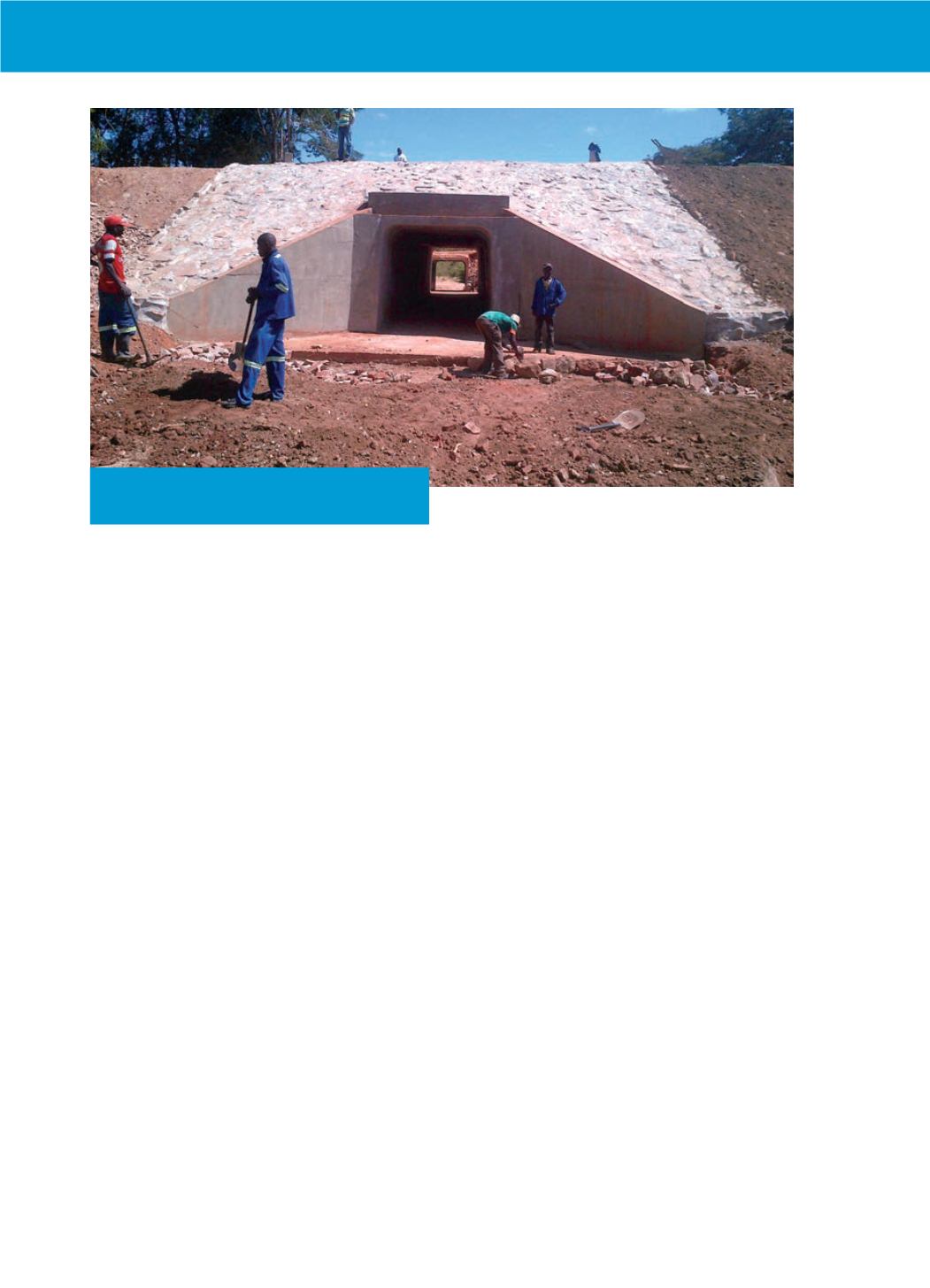
Housing and infrastructure are priorities
for Zambia’s economy


