187
Agriculture
Seeds
Encompassing all public and private activities in
plant breeding, variety development, seed produc-
tion, and distribution, the seed industry is made up of
formal and informal sectors. The Seed Control and
Certification Institute (SCCI) is the seed certification
authority in Zambia, providing seed quality control
services to private seed companies, seed programs,
NGOs, seed traders, and farmers. The Zambia Seed
Trade Association (ZASTA) is the national seed as-
sociation that looks after the interests of all players
in the country’s seed trade. The seed industry has
registered increased participation by the private sec-
tor, with research concentrated on maize, soybeans,
wheat, and cotton. It also focuses on commercial
crop production.
Horticul
ture and Fl
oricul
ture
Both horticulture and floriculture do exceedingly well
in Zambia’s temperate climate. Production of fresh
vegetables and flowers mainly for export, recorded
significant growth during the early part of the de-
cade. As both subsectors are highly labor intensive,
they are promoted as part of government’s poverty
reduction program.
Development in the subsector has been marked by
investment in year-round irrigated production by me-
dium and large-scale farmers as well as the expan-
sion of out-grower schemes. Zambia produces more
than 60 varieties of cut flowers, and it is focusing on
the expansion of rose production. At the moment it
mostly supplies to the EU.
Tropical fruits and fresh vegetables grown in Zambia
also are prominently featured in the export markets
of the UK, South Africa, Germany, the Netherlands,
Australia, New Zealand, Norway, and France. The
rise in the prepackaging of vegetables in Zambia has
added value to such horticultural exports in recent
years.
LIVESTOCK
Approximately 80 percent of the industry remains
at the small-scale operational level, with many beef
and dairy cattle raised solely for domestic use. While
grazing conditions suit a variety of livestock, distri-
bution is uneven and some areas are subject to the
negative effects of the tsetse flies. The eradication
of livestock diseases is a top priority, and steps have
been taken to educate farmers about the dangers of
moving animals from one area to another. The re-
stocking of affected herds is an ongoing but progres-
sively improving process.
The poultry subsector has grown tremendously in
the past decade, although a shortage of day-old
chicks has constrained, to some extent, further ex-
pansion in the market.
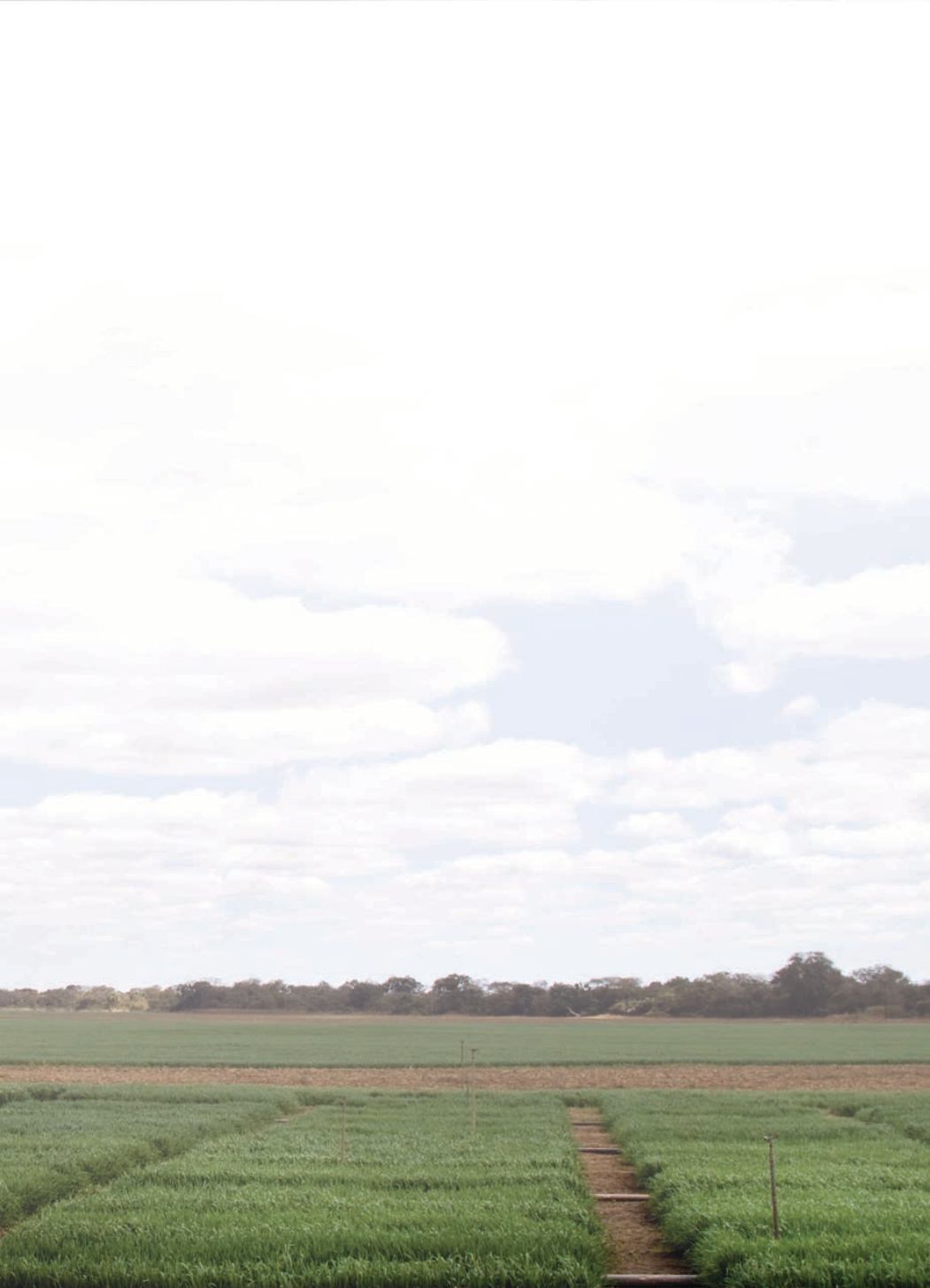
Landscape of crops in rural Zambia


